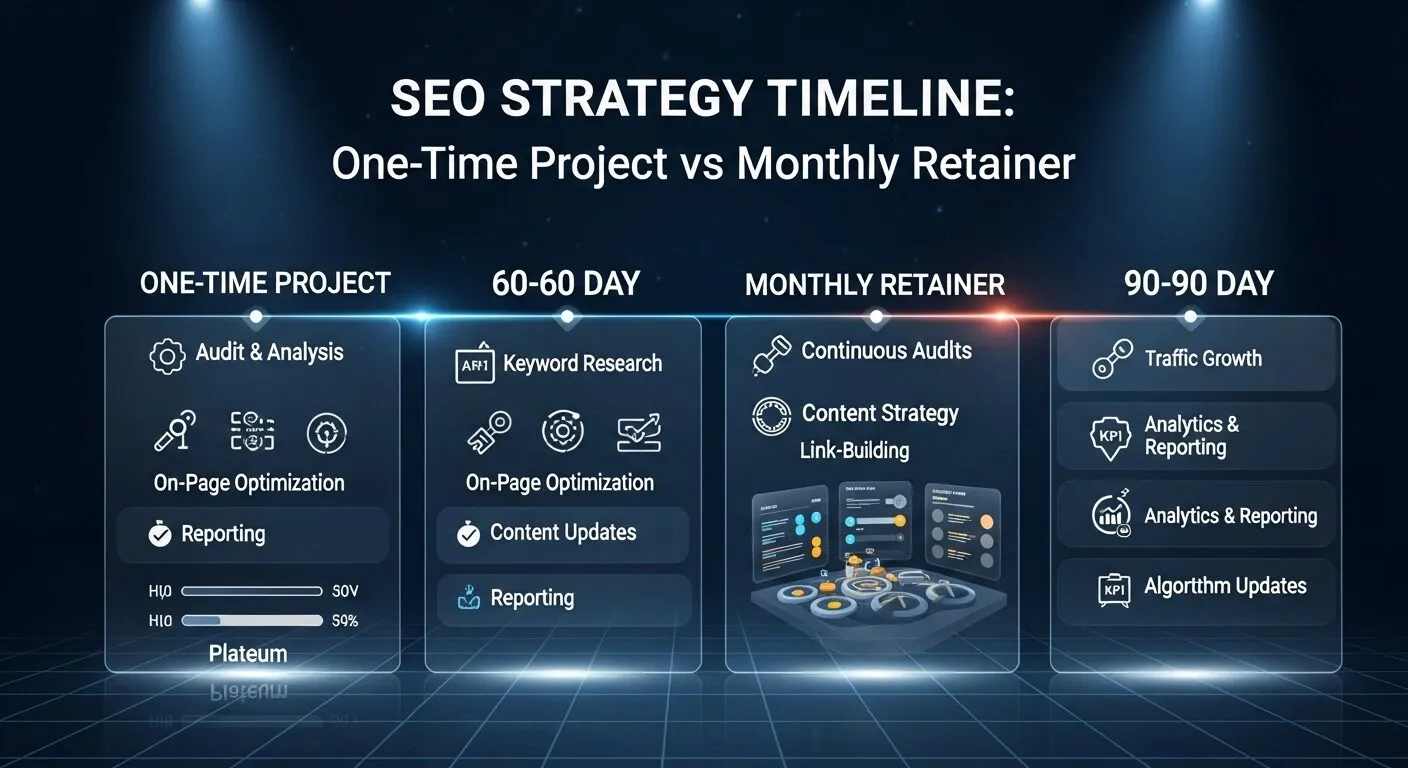
A one-time SEO project is best when your website needs a fixed piece of work, such as an audit, migration, technical cleanup, or page optimization. A monthly SEO retainer is better when you need ongoing content, monitoring, technical maintenance, local visibility, authority building, and steady organic growth.
What Is a Monthly SEO Retainer?
A monthly SEO retainer is an ongoing agreement where a business pays an SEO consultant or agency every month to improve and maintain organic search performance.
A retainer usually includes strategy, technical monitoring, keyword research, content planning, content updates, internal linking, reporting, and performance review. Some retainers also include local SEO, digital PR, conversion improvements, or website support.
The main purpose of a retainer is continuity. SEO changes over time because competitors publish new content, search behavior changes, websites develop technical issues, and business priorities shift. A retainer gives the SEO team time and scope to keep improving the site instead of fixing it once and leaving it alone.
What Is a One-Time SEO Project?
A one-time SEO project is a fixed-scope SEO engagement with a clear start date, deliverables, and end date.
Common one-time SEO projects include:
A one-time project works well when the problem is specific and the business has the internal team to implement and maintain the recommendations after the project ends.
Monthly SEO Retainer vs One-Time SEO Project: Quick Comparison
| Factor | Monthly SEO Retainer | One-Time SEO Project |
|---|---|---|
| Best For | Ongoing growth and competitive markets | Fixed problems and foundation work |
| Scope | Continuous and flexible | Defined and limited |
| Timeline | Usually measured over months | Usually completed in weeks |
| Main Benefit | Compounding improvement | Fast cleanup or setup |
| Main Risk | Paying monthly without clear work | No follow-through after delivery |
| Content Creation | Ongoing | Limited or none |
| Technical Monitoring | Continuous | Point-in-time |
| Reporting | Monthly or periodic | Final report or handoff |
| Competitive Response | Strong | Weak after project ends |
| Best Buyer | Business seeking sustained organic growth | Business needing a specific SEO fix |
The Main Difference Is Not Price. It Is Continuity.
Many businesses compare retainers and projects only by cost. That is the wrong starting point.
The real difference is continuity.
A one-time project can fix known issues. It can improve crawlability, page structure, metadata, internal links, redirects, schema, or content quality on selected pages. But once the work ends, the site stops receiving active SEO attention. Businesses looking for long-term SEO support can work with Aspire Digital Solutions for continuous optimization, performance monitoring, and sustainable organic growth.
A monthly retainer keeps the improvement cycle running. The team can measure what happened, find new search opportunities, improve pages, create supporting content, adjust internal links, review technical health, and respond to changes in competition.
In simple terms:
A one-time SEO project fixes a defined SEO problem.
A monthly SEO retainer manages SEO as a growth system.
When a One-Time SEO Project Is Enough
A one-time SEO Services in Mysore project may be enough when the website has a clear issue that can be solved with a limited scope.
An SEO audit is useful when you do not know why rankings, traffic, or leads are weak. The audit should review technical issues, indexation, content quality, keyword targeting, internal links, competitors, and conversion paths.
An audit is a project. Implementation may become a separate project or a monthly retainer.
Website migrations are risky because URLs, redirects, internal links, metadata, content, and tracking can break during the move. A one-time migration SEO project can protect existing rankings and reduce traffic loss.
This type of project should include redirect mapping, pre-launch checks, post-launch crawl checks, analytics review, and indexation monitoring.
If your site has crawl errors, duplicate pages, broken links, poor page speed, missing canonicals, bad redirects, or indexing problems, a technical SEO cleanup can be handled as a project.
This works best when the site is small or medium-sized and the technical issues are clearly defined.
If your service pages, category pages, or landing pages are thin, unclear, or poorly structured, a one-time on-page SEO project can improve them.
This may include title tags, headings, content depth, internal links, FAQs, schema markup, and conversion-focused page structure.
Some businesses operate in markets where competitors do little SEO. In that case, a strong foundation may work for a longer period.
This is common in small local niches, specialized B2B services, or businesses with limited online competition.
When a Monthly SEO Retainer Is the Better Choice
A monthly SEO retainer is usually better when SEO must keep improving to support business growth.
If competitors keep adding service pages, blogs, comparison guides, case studies, local pages, or backlinks, a one-time project will not keep pace for long.
Ongoing SEO helps your site keep building topical depth and authority.
Technical SEO creates the foundation, but growth often needs content, internal linking, authority, page updates, and better alignment with buyer intent.
A monthly retainer gives the SEO team time to improve the whole organic system.
Competitive keywords require repeated improvement. One page update is rarely enough.
You may need supporting content, better page structure, stronger internal links, case studies, expert input, and ongoing refinement based on performance data.
If organic search is an important lead source, SEO should not be treated as a one-time repair.
A retainer helps protect and improve a channel that supports sales, inquiries, bookings, demos, or store visits.
Local SEO often needs ongoing work because rankings depend on location relevance, service pages, reviews, Google Business Profile activity, local content, citations, and competitor movement.
A one-time setup can help, but monthly local SEO is better when local leads matter.
The Hybrid Model: Start With a Project, Then Move to a Retainer
Many businesses do not need to choose one model forever.
A practical path is:
This prevents waste. It also helps the business avoid paying monthly before the SEO team knows what needs to be done.
Decision Matrix: Which SEO Model Should You Choose?
| Business Situation | Best Model | Reason |
|---|---|---|
| New website with no SEO setup | One-time project first | Foundation work is needed before growth work |
| Website migration or redesign | One-time project | The scope is specific and time-bound |
| Severe technical SEO issues | One-time project or short retainer | Fixes may need focused implementation |
| Competitive industry | Monthly retainer | Competitors keep improving |
| Local business needing leads | Monthly retainer | Reviews, pages, and visibility need maintenance |
| Ecommerce site with many products | Monthly retainer | Category, product, and technical work is ongoing |
| Small site in low-competition niche | One-time project may be enough | Limited competition may reduce ongoing need |
| Business has in-house content team | Project plus advisory retainer | Internal team can execute some work |
| Business has no SEO team | Monthly retainer | External execution is needed |
| Rankings dropped after updates | Audit first, then retainer if needed | Diagnosis should come before execution |
Five-Factor SEO Decision Framework
Use these five factors to decide between a retainer and a project.
Ask:
If the main issue is technical debt, start with a one-time technical SEO project.
Ask:
If the main issue is content depth, a monthly retainer is usually better.
Ask:
If competition is active, ongoing SEO is usually needed.
Ask:
If your internal team can execute, a project may be enough. If not, a retainer is safer.
Ask:
If the goal is growth, choose a retainer or a phased SEO plan.
Simple Scoring System
Give each factor a score from 1 to 5.
| Factor | 1 Means | 5 Means |
|---|---|---|
| Technical Debt | Site is healthy | Major technical problems |
| Content Gap | Content is strong | Many missing topics |
| Competition | Low competition | Strong SEO competitors |
| Internal Resources | Strong in-house team | No SEO/content support |
| Growth Pressure | Maintenance only | Aggressive growth needed |
| Total Score | Recommendation |
|---|---|
| 5–10 | One-time SEO project may be enough |
| 11–17 | Start with a project, then review |
| 18–25 | Monthly SEO retainer is likely better |
What a One-Time SEO Project Should Include
A strong one-time SEO project should include clear deliverables.
SEO Audit Project
Should include:
Technical SEO Project
Should include:
On-Page SEO Project
Should include:
Migration SEO Project
Should include:
What a Monthly SEO Retainer Should Include
A useful SEO retainer should not be vague. It should include a monthly plan, clear deliverables, and performance review.
A strong retainer may include:
The exact mix should depend on the site's needs. A local business may need more Google Business Profile and location-page work. An ecommerce site may need category optimization and technical monitoring. A B2B company may need comparison pages, service pages, and thought-leadership content.
Diagnostic Checklist Before Buying SEO
Use this checklist before choosing a project or retainer.
Choose a One-Time SEO Project If:
Choose a Monthly SEO Retainer If:
Common Mistakes Businesses Make
Mistake 1: Buying a Retainer Without a Roadmap
A monthly fee does not guarantee growth. Ask what will be done in the first month, second month, and third month.
Mistake 2: Expecting an Audit to Create Growth by Itself
An audit finds problems. It does not fix them unless implementation is included.
Mistake 3: Measuring Only Traffic
Traffic is useful, but it is not the full goal. Track qualified leads, calls, forms, bookings, revenue, ranking coverage, and page-level conversions.
Mistake 4: Stopping Before SEO Has Enough Data
SEO often needs repeated measurement. If you stop before implementation has time to be measured, you may not learn what worked.
Mistake 5: Publishing Content Without Strategy
More content is not automatically better. Each page should have a clear intent, audience, keyword set, internal link role, and conversion purpose.
Mistake 6: Ignoring Technical Maintenance
Websites change. New pages, plugins, themes, scripts, and redirects can create SEO issues. Ongoing checks prevent small problems from becoming major losses.
Edge Cases
Edge Case 1: The Site Has Strong Content but Poor Technical Health
Start with a technical SEO project. Once the foundation is stable, consider a smaller retainer for monitoring and content updates.
Edge Case 2: The Site Is Technically Healthy but Has Weak Content
A monthly content-focused retainer is usually better than a one-time project.
Edge Case 3: The Business Has Seasonal Demand
Use a project before the season starts, then a short retainer during peak months for monitoring, updates, and conversion improvement.
Edge Case 4: The Business Has an Internal Marketing Team
Use a one-time strategy project, then a light advisory retainer. The agency can guide while the internal team executes.
Edge Case 5: The Business Has No Developer
Avoid audit-only projects. If no one can implement the audit, choose a project or retainer that includes implementation support.
Local SEO Context
For local businesses, the decision depends on how competitive the city or service area is.
A one-time local SEO project can help with:
A monthly local SEO retainer is better when:
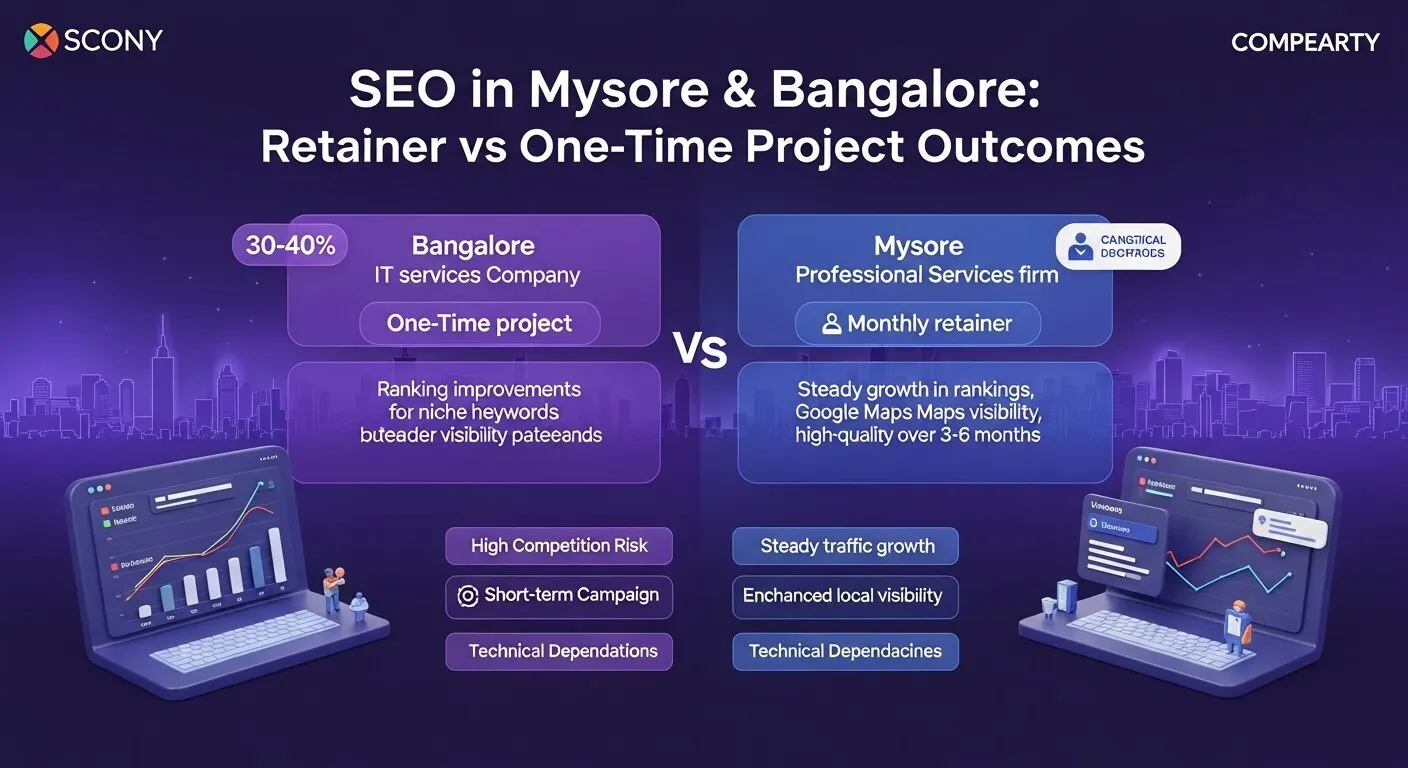
For a local service business, SEO is not only about ranking a page. It is also about matching service intent, location intent, trust signals, reviews, and conversion paths. Businesses investing in SEO Services in Mysore or SEO Services in Bangalore benefit from ongoing local optimization that adapts to market conditions.
Expert Commentary
The best SEO model is not the one with the longest contract. It is the one that matches the type of problem.
If the site has a fixed issue, use a project. If the business needs ongoing market growth, use a retainer. If the business is unsure, start with an audit and build the next phase from evidence.
A good SEO provider should be able to say, "You do not need a retainer yet," when a project is the better first step.
For a deeper understanding of how SEO operates in the Indian market, read How SEO Actually Works in India in 2026.
How to Measure Success
For a One-Time SEO Project
Measure:
For a Monthly SEO Retainer
Measure:
Final Decision: Which One Should You Pick?
Choose a one-time SEO project if you need a clear fix, audit, migration, technical cleanup, or foundation setup.
Choose a monthly SEO retainer if SEO is expected to support ongoing leads, sales, local visibility, content growth, or competition response.
Choose a hybrid model if you are unsure. Start with an audit or strategy project, complete the most important fixes, then move into monthly SEO only when there is a clear roadmap.
The strongest choice is the one that matches your site condition, competition level, team capacity, and growth goal. To explore how Aspire Digital Solutions structures SEO engagements, visit our services page or review Local SEO vs National SEO to understand which approach fits your market.
FAQs
SEO can be a one-time project when the goal is a fixed task such as an audit, migration, or technical cleanup. SEO becomes ongoing when the goal is growth, content expansion, local visibility, or stronger rankings in a competitive market.
A monthly SEO retainer is worth it when the work is tied to clear deliverables, business goals, and reporting. It is not worth it if the scope is vague or the provider cannot explain what will be done each month.
Yes. This is often the best path. A project can diagnose and fix the foundation. A monthly plan can then build content, authority, and long-term performance.
Stay on a retainer as long as there is clear work to do and measurable business value. Review progress every three months. If the roadmap becomes weak or results are unclear, adjust the scope.
A monthly SEO retainer should include strategy, technical monitoring, content planning, page optimization, internal linking, reporting, and performance review. The exact scope should match the site's goals.
A one-time SEO project should include a clear scope, deliverables, timeline, implementation plan, and success metrics. Examples include audits, migrations, technical fixes, on-page optimization, and keyword mapping.
Small businesses with simple websites may start with a one-time SEO project. Small businesses in competitive local markets usually benefit more from monthly SEO because local competitors, reviews, and service pages need ongoing work.
They fail when recommendations are not implemented, when the market is competitive, when content gaps remain, or when no one monitors performance after delivery.
They fail when there is no roadmap, no accountability, no implementation, weak reporting, or too much focus on activity instead of business outcomes.