What Is the Difference Between a Google Ads Agency and an In-House PPC Manager?
A Google Ads agency is an external paid media partner that manages campaigns, tracking, reporting, testing, and optimization across one or more ad platforms. A good agency usually gives you access to several skills at once: paid search strategy, conversion tracking, landing page feedback, Shopping feed knowledge, Performance Max oversight, reporting, and budget planning.
In-House PPC Manager
An in-house PPC manager is an employee who manages Google Ads from inside the business. This person has direct access to product updates, sales feedback, pricing changes, margin data, promotions, and leadership priorities. The advantage is context. The risk is that one person may be expected to handle strategy, execution, analytics, reporting, creative testing, and troubleshooting alone.
The Real Question
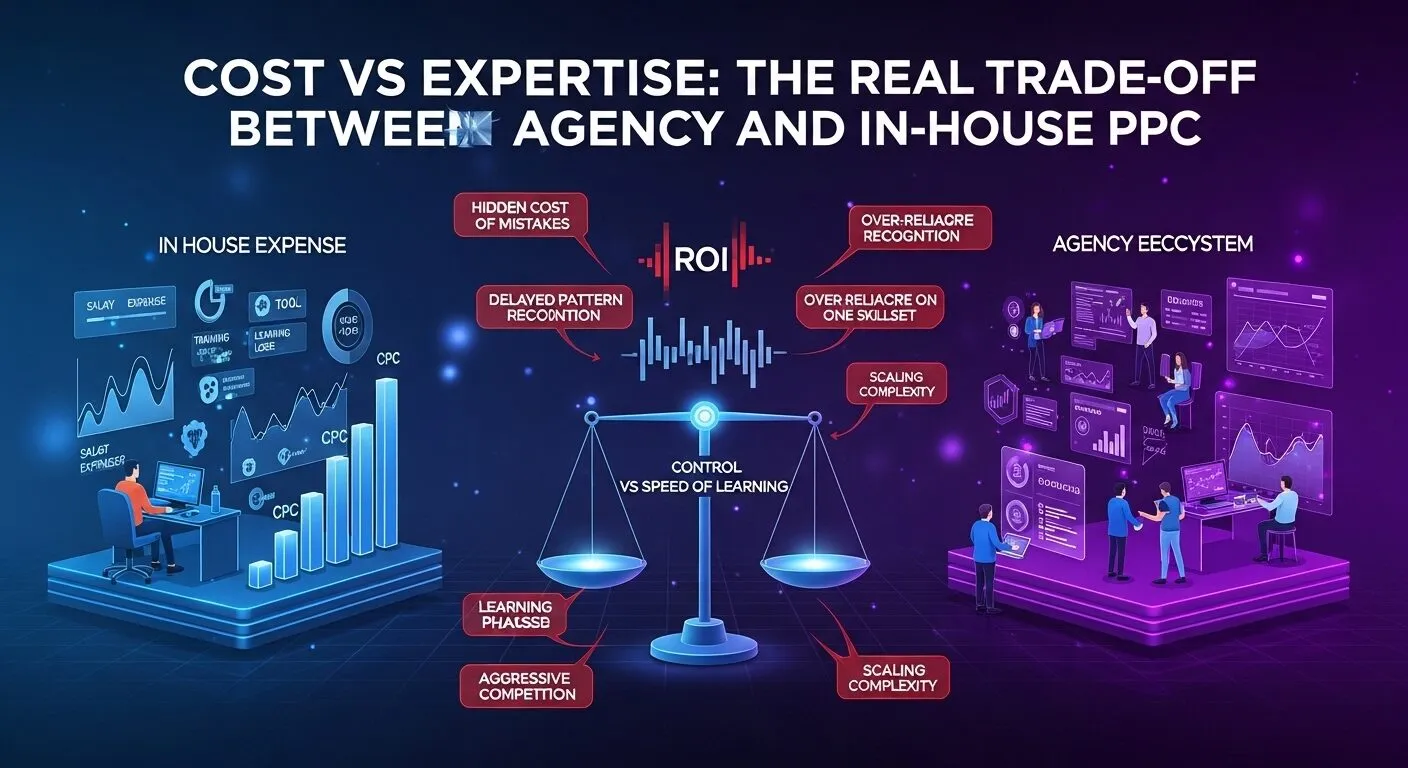
The real question is not "agency or employee?" The better question is:
Which model gives your business the best mix of skill, speed, control, accountability, and cost at your current stage?
Businesses that also want to strengthen their organic presence alongside paid campaigns can benefit from SEO Services in Bangalore to build consistent long-term traffic and visibility.
Google Ads Agency vs In-House PPC Manager: Quick Comparison
| Factor | Google Ads Agency | In-House PPC Manager |
|---|---|---|
| Specialist depth | Strong if the agency has experienced PPC staff | Depends on one person's skill |
| Brand knowledge | Must be learned | Strong from day one |
| Speed of execution | Fast if processes are strong | Fast for internal approvals |
| Tool access | Usually included in the agency stack | Must be bought separately |
| Cost structure | Monthly fee, percentage of spend, or hybrid fee | Salary, benefits, tools, training, management |
| Accountability | External partner must prove value | Internal reporting depends on company structure |
| Scalability | Easier to add skills without hiring | Requires more hiring as complexity grows |
| Control | Lower day-to-day control | Higher direct control |
| Best fit | Small to mid-sized accounts, fast growth, skill gaps | Large accounts, deep internal coordination, complex product data |
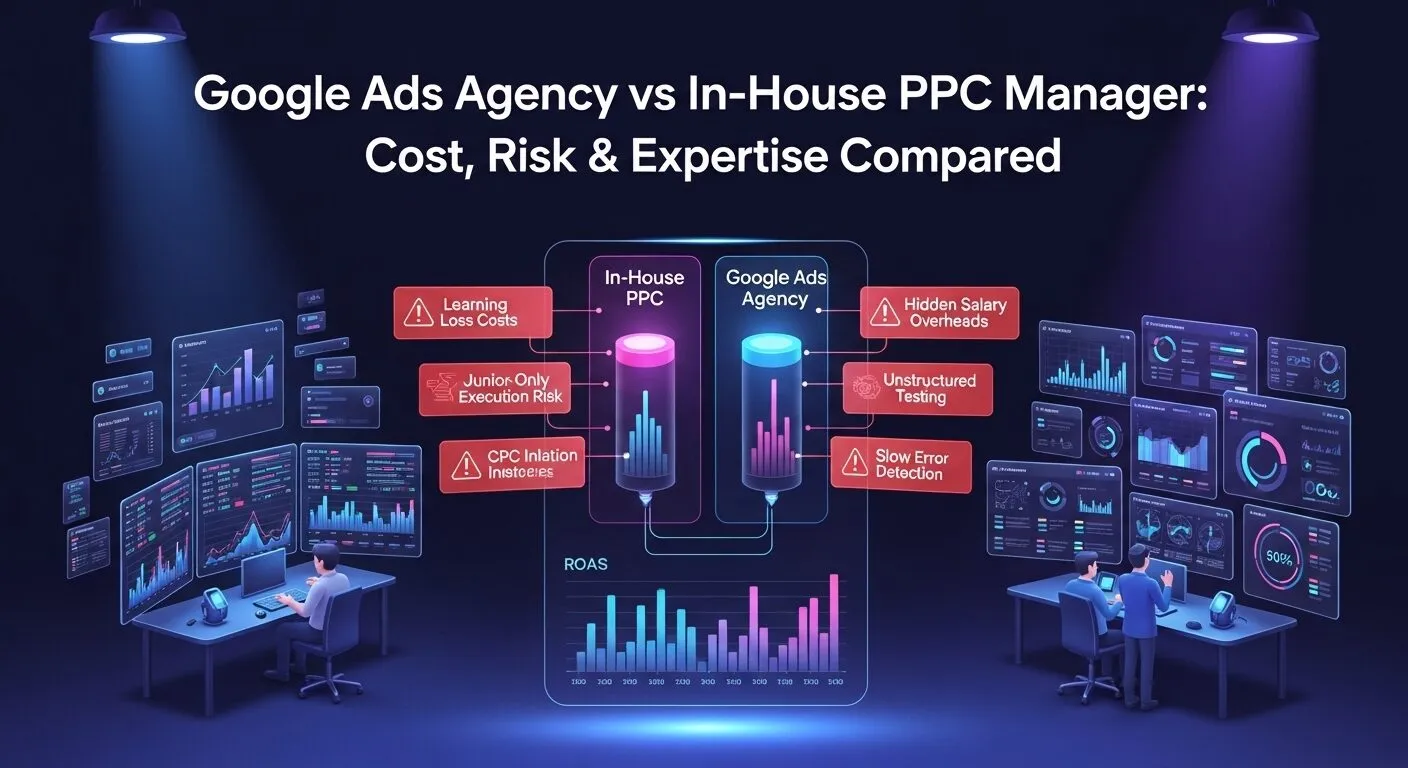
The Cost Comparison Is Bigger Than Salary vs Agency Fee
Many businesses compare an agency's monthly fee against a PPC manager's salary. That is too narrow.
The real cost of an in-house PPC manager includes:
The real cost of an agency includes:
A PPC agency can look more expensive than an employee at first glance. But if the agency replaces several skills that one employee cannot cover alone, the value can be higher. Businesses looking for experienced PPC management can work with Aspire Digital Solutions for campaign strategy, optimization, conversion tracking, and ongoing performance improvement.
An in-house manager can look cheaper once ad spend is high. But if that person lacks support in analytics, landing pages, feed management, or strategy, the account may still underperform.
The Break-Even Question: When Does In-House Make Sense?
In-house PPC starts to make more sense when three conditions are true:
For many growing businesses, the best path is not a clean switch from agency to in-house. It is a staged model:
| Business Stage | Best PPC Model |
|---|---|
| Early stage with limited ad spend | Freelancer or small specialist agency |
| Growing business with active testing | Specialist Google Ads agency |
| Mid-sized business with internal marketing team | Agency plus internal marketing lead |
| Larger business with complex operations | In-house PPC lead plus agency support |
| Enterprise-level account | Internal paid media team with agency audits or specialist projects |
What a Good Google Ads Agency Does Better
A strong Google Ads agency does more than adjust bids. It improves the system around paid search.
1. It Reduces Wasted Spend
Wasted spend usually comes from poor keyword matching, weak negative keyword control, irrelevant search terms, loose Performance Max signals, low-quality placements, broken tracking, and landing pages that do not convert.
A strong agency reviews where budget is leaking and fixes the causes.
2. It Brings Cross-Account Learning
An agency sees patterns across multiple accounts. That gives it faster feedback on what is working across industries, campaign types, bidding models, and landing page structures.
An in-house PPC manager sees one business deeply. An agency sees many accounts broadly. Both types of knowledge matter.
3. It Gives Access to Multiple Specialists
A single PPC manager may be good at Search campaigns but weaker in Shopping, feed optimization, conversion tracking, GA4, landing page analysis, or B2B lead quality measurement.
A strong agency can bring different people into the account when needed.
4. It Scales Faster
If your business adds a new location, product line, campaign type, or market, an agency can usually assign more resources faster than a company can hire and train another employee.
5. It Adds External Accountability
An agency must justify its fee. This creates pressure to report, explain, test, and improve. The best agencies connect PPC work to business outcomes, not vanity metrics.
What an In-House PPC Manager Does Better
A strong in-house PPC manager can be more valuable than an agency when the business needs close daily coordination.
1. They Understand the Business Faster
An internal PPC manager hears sales calls, joins product meetings, sees margin changes, and understands customer quality more deeply.
That matters when not all conversions are equal.
2. They Can Act Quickly on Internal Changes
If pricing changes, stock runs low, a location closes, or a sales team reports poor lead quality, an internal manager can respond quickly.
3. They Keep Knowledge Inside the Company
Campaign learning, test history, and customer insights stay inside the business. This can be valuable when paid search is a major growth channel.
4. They Can Work Closely With Sales and Product Teams
For B2B, SaaS, eCommerce, healthcare, legal, and local services, the PPC manager often needs feedback from other teams. Internal access can improve decision-making.
The Biggest Mistake: Hiring One PPC Manager to Do a Team's Job
The in-house model often fails when a business hires one PPC manager and expects that person to act as:
That is not a role. That is a full paid media function.
If you hire in-house, define the role clearly. Decide what the manager owns and what support they need from analytics, design, development, sales, and leadership.
The Biggest Agency Risk: Low Attention
The agency model often fails when the agency has too many accounts per manager.
A strong agency should be able to answer:
If the answers are vague, the agency may be selling service capacity it cannot properly deliver.
Many local brands address this gap by working with Google Ads Services in Mysore specialists who understand regional search behavior and budget control.
Decision Matrix: Which PPC Model Should You Choose?
Score each factor from 1 to 5.
| Question | Low Score Means | High Score Means |
|---|---|---|
| Is monthly ad spend high? | Agency likely works better | In-house may be viable |
| Is campaign complexity high? | Agency or freelancer can manage | Hybrid or internal team may help |
| Is internal data critical? | Agency can work with reports | In-house has stronger context |
| Is speed needed now? | Hiring can wait | Agency may be faster |
| Is specialist skill missing internally? | Agency likely needed | In-house can lead |
| Can you manage a PPC employee well? | Agency safer | In-house more realistic |
| Do you need multiple PPC skills? | Agency stronger | Internal team required, not one hire |
| Is account ownership important? | Must be enforced either way | Must be enforced either way |
Simple Scoring Rule
| Points | Recommendation |
|---|---|
| 8–18 points | Use a specialist agency or freelancer. |
| 19–28 points | Use an agency with a strong internal coordinator. |
| 29–35 points | Use a hybrid model with an in-house PPC lead and agency support. |
| 36–40 points | Build an internal PPC team, with external audits when needed. |
When a Google Ads Agency Is the Better Choice
Choose a Google Ads agency when:
An agency is usually the safer choice when the business has budget pressure, weak tracking, poor reporting, or slow testing.
For a clearer decision path, see SEO vs Google Ads: Which One Should You Invest In First?
When an In-House PPC Manager Is the Better Choice
Hire in-house when:
An in-house PPC manager is strongest when the business already has marketing maturity and needs deeper internal control.
Businesses investing in Google Ads Services in Bangalore may evaluate this path once their account complexity justifies dedicated internal ownership.
The Hybrid Model Often Gives the Best Result
A hybrid model uses both internal knowledge and external skill.
Hybrid Model 1: Agency-Led, Internal Coordinator
The agency manages campaigns. The internal person gives business context, approves priorities, shares sales feedback, and checks that PPC work fits the company's goals.
Best for growing businesses that need specialist execution without hiring a full PPC team.
Hybrid Model 2: In-House Lead, Agency Support
The in-house PPC manager owns strategy and daily decisions. The agency supports advanced work, audits, tracking, feed issues, experiments, or new campaign launches.
Best for larger accounts where internal control matters but outside review is still useful.
Hybrid Model 3: Agency Builds the System, In-House Takes Over Later
The agency audits the account, fixes tracking, builds reporting, documents processes, and trains the internal team over time.
Best for businesses that want internal ownership later but do not yet have the system or skill to do it safely.
AI and Automation Do Not Remove the Need for PPC Expertise
Google Ads now uses more automation across bidding, targeting, creative assembly, and campaign delivery. Smart Bidding, Performance Max, broad match, and AI-assisted campaign features can improve efficiency when the inputs are strong.
But automation still needs human judgment.
A PPC expert must decide:
AI can help execute. It does not replace business strategy.
Diagnostic Checklist: Is Your Current PPC Setup Weak?
Use this checklist before choosing agency or in-house.
| Diagnostic Question | Risk If Answer Is "No" |
|---|---|
| Is conversion tracking accurate? | The system may optimize for bad data |
| Are phone calls, forms, purchases, and offline sales tracked correctly? | ROI may be misread |
| Are negative keywords reviewed regularly? | Budget may leak into irrelevant queries |
| Are search terms reviewed by intent? | Informational clicks may drain budget |
| Are landing pages tested? | CPC gains may not convert into revenue |
| Are reports tied to revenue or qualified leads? | Clicks may be mistaken for success |
| Is Performance Max reviewed by asset, feed, audience, and channel signals? | Automation may hide waste |
| Is lead quality fed back into Google Ads? | Campaigns may optimize for weak leads |
| Does someone own weekly testing? | Performance may become flat |
| Does leadership know the real CPA or ROAS target? | Budget decisions may be emotional |
If several answers are "no," the first priority is not choosing a management model. The first priority is a PPC audit.
Common Mistakes When Choosing an Agency
Low fees can mean low attention, junior staff, weak reporting, or rushed work. Cost matters, but poor campaign management can waste more than the fee saves.
Impressions, clicks, and CTR matter only when connected to qualified leads, sales, revenue, profit, or pipeline.
Your business should retain access to its own Google Ads account, campaign history, and conversion data.
The sales team may sound strong, but the real result depends on the person doing the work.
A good agency should explain what will happen during audit, cleanup, tracking review, testing, and optimization.
Common Mistakes When Hiring In-House
A junior marketer may know the interface but lack the judgment needed to manage serious ad spend.
A PPC manager without proper reporting, tracking, keyword, feed, or landing page tools may work slower and miss issues.
If one person owns all PPC knowledge and leaves, campaign performance can suffer quickly.
Even strong PPC managers benefit from external audits. Paid search changes fast, and blind spots build over time.
More leads are not always better. Lead quality, close rate, revenue, and profit matter more.
Industry-Specific Guidance
Local Service Businesses
A specialist agency usually works better because ad spend is often not high enough to justify a full-time PPC hire. Local targeting, call tracking, landing pages, and lead quality checks are key.
eCommerce
A hybrid model can work well. Keep product, pricing, margin, and feed data close to the business, while using agency skill for Shopping, Performance Max, testing, and scaling.
B2B and SaaS
Do not optimize only for form fills. Connect Google Ads to CRM stages, sales-qualified leads, pipeline, and customer value. A hybrid model is often strongest.
Legal, Finance, and Healthcare
High click costs make mistakes expensive. Use specialist PPC support, strict compliance checks, careful keyword control, and strong landing page quality.
Multi-Location Businesses
Agency support can help standardize structure and reporting, while internal teams provide location-level service data and market feedback.
90-Day Plan for Switching PPC Management Models
Days 1–15: Audit and Access
Check Google Ads access, conversion tracking, billing, search terms, campaign structure, landing pages, and reporting.
Days 16–30: Fix the Data
Repair broken conversions, duplicate goals, missing call tracking, weak CRM imports, and poor naming structure.
Days 31–60: Reduce Waste
Add negative keywords, restructure weak campaigns, pause poor traffic sources, improve ad relevance, and focus budget on high-intent queries.
Days 61–90: Build the Growth System
Launch controlled tests, improve landing pages, refine bidding, review lead quality, and create a monthly decision report.
This plan works whether you move from in-house to agency, agency to in-house, or agency-only to hybrid.