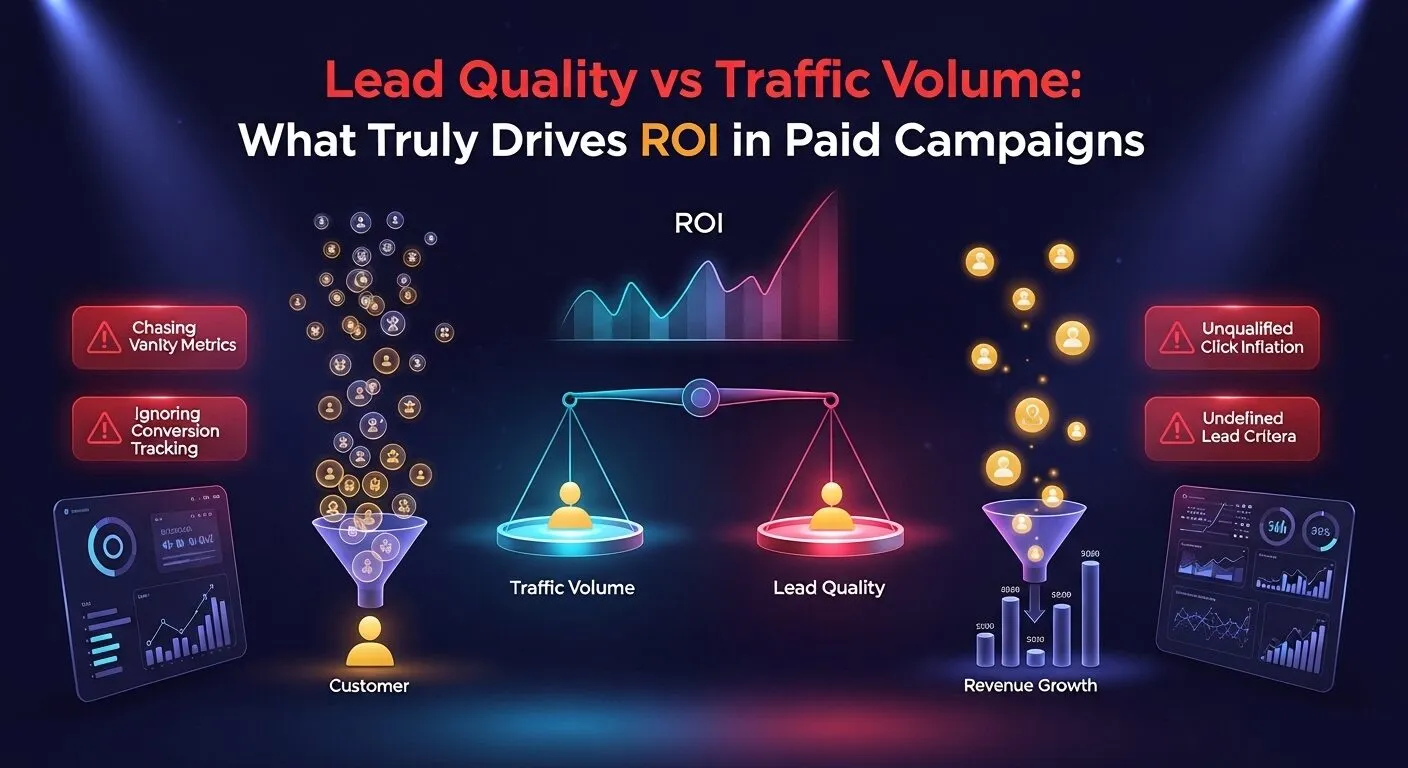
Lead quality matters more than traffic volume when the goal is revenue, enquiries, bookings, calls, demos, or sales. Traffic volume shows how many people visit a website. Lead quality shows whether those visitors are relevant, interested, reachable, financially suitable, and likely to become customers. The strongest marketing strategy improves both, but it measures success by qualified opportunities, not visits alone. Our Google Ads services are built around this exact balance.
In our experience working with Mysore and Bangalore-based businesses at Aspire Digital Solutions , campaigns succeed when the strategy balances quantity and quality, aligned with business goals, budgets, and market behavior.
What Is Traffic Volume?
Traffic volume is the number of users who visit a website, landing page, blog, service page, product page, or campaign page during a specific period.
Traffic can come from:
Traffic is useful because it shows reach. A website with no visitors has limited opportunity to generate leads. But traffic alone does not prove business growth.
A page can receive thousands of visits and still fail if the visitors are not looking for the service, not in the right location, not ready to enquire, or not able to buy.
What Is Lead Quality?
Lead quality measures how valuable a lead is to the business.
A strong lead usually has five qualities:
For example, a clinic in Mysore may get 1,000 monthly visitors from general health blogs. That traffic may look good in a report. But one enquiry from a patient searching for a specific treatment in Mysore may be more valuable than hundreds of low-intent visits.
Lead Quality vs Traffic Volume: Main Difference
| Factor | Traffic Volume | Lead Quality |
|---|---|---|
| What it measures | Number of visitors | Value and readiness of enquiries |
| Main question | How many people came? | How many useful prospects came? |
| Best for | Awareness and reach | Revenue and sales growth |
| Risk | Vanity reporting | Lower volume may look weak without context |
| Key metric | Sessions, users, page views | Qualified leads, sales calls, proposals, customers |
| Business value | Indirect | Direct |
| Best use | Growing visibility | Improving conversion and sales efficiency |
Traffic volume fills the top of the funnel. Lead quality determines whether that funnel can produce revenue.
Why High Traffic Does Not Always Create Leads
High traffic can fail when the search intent and business offer do not match.
This usually happens for six reasons.
1. The Keywords Are Too Broad
A website may rank for broad informational terms that bring visitors but not buyers.
Example:
| Broad Keyword | Better Lead-Focused Keyword |
|---|---|
| digital marketing | digital marketing agency for real estate leads |
| website design | website design company for clinics |
| SEO tips | SEO agency for local businesses |
| Google Ads | Google Ads agency for qualified leads |
Broad keywords can support awareness, but commercial keywords usually create stronger enquiries.
2. The Visitors Are Outside the Service Area
A local business may get visitors from cities or countries it does not serve. That traffic increases analytics numbers but does not help the sales team.
For a Bangalore or Mysore service business, location relevance matters. A lead from the correct city, area, or service radius is usually more valuable than general national traffic.
3. The Page Answers Questions but Does Not Create Action
Some pages educate users but do not guide them to the next step.
A strong lead-focused page should include:
Traffic without a clear conversion path becomes passive attention.
4. The Offer Is Not Specific Enough
People convert when the offer matches their problem.
Weak offer: "We provide marketing services."
Stronger offer: "Get a campaign audit to find why your ads are getting clicks but not qualified leads."
Specific offers attract serious prospects and filter casual visitors.
5. Forms Are Too Open
A short form may increase lead count, but it can also increase weak enquiries.
A better form asks useful qualification questions without becoming too long.
Good qualification fields include:
6. Campaigns Are Optimized for Clicks Instead of Business Outcomes
Paid campaigns can bring many clicks when targeting is broad. But clicks are not the final goal.
A better campaign tracks:
The campaign should learn from lead quality, not only click volume.
The Traffic-to-Revenue Ladder
Use this ladder to understand where marketing performance breaks.
| Stage | What Happens | Main Metric | Failure Signal |
|---|---|---|---|
| 1. Visibility | People see the brand | Impressions | No search visibility |
| 2. Traffic | People visit the site | Sessions/users | Visitors leave quickly |
| 3. Engagement | Visitors read or interact | Scroll, clicks, time on page | No service-page engagement |
| 4. Conversion | Visitors enquire | Calls, forms, chats | Traffic but no enquiries |
| 5. Qualification | Leads are reviewed | Qualified lead rate | Many weak or irrelevant leads |
| 6. Sales Opportunity | Lead enters sales process | Meetings, demos, quotes | Leads do not respond |
| 7. Customer | Lead becomes revenue | Sales, bookings, contracts | Proposals do not close |
| 8. Retention | Customer stays or returns | Repeat revenue, LTV | One-time low-value sales |
Most businesses stop reporting at stage 2 or 4. Better marketing reports continue until stage 7 or 8.
How to Measure Lead Quality
Lead quality should be measured with a simple scoring model.
The 5F Lead Quality Score
Score each lead from 1 to 5 for each factor.
| Factor | Question | Score |
|---|---|---|
| Fit | Does this person match the ideal customer profile? | 1–5 |
| Focus | Is the enquiry about the right service? | 1–5 |
| Funding | Does the person have a suitable budget? | 1–5 |
| Funnel Stage | Is the person ready to act soon? | 1–5 |
| Follow-Up Readiness | Can the sales team contact them easily? | 1–5 |
Score meaning:
| Total Score | Lead Type | Action |
|---|---|---|
| 21–25 | High-quality lead | Prioritize immediately |
| 16–20 | Good lead | Follow up quickly |
| 11–15 | Nurture lead | Educate and retarget |
| 6–10 | Weak lead | Filter or lower priority |
| 1–5 | Poor lead | Exclude from campaign learning |
This scoring system helps marketing and sales teams speak the same language.
Important Lead Quality Metrics
| Metric | Formula | Why It Matters |
|---|---|---|
| Lead Conversion Rate | Leads ÷ visitors × 100 | Shows how well traffic converts |
| Qualified Lead Rate | Qualified leads ÷ total leads × 100 | Shows lead relevance |
| Sales Acceptance Rate | Sales-accepted leads ÷ total leads × 100 | Shows whether sales trusts the leads |
| Contactability Rate | Reachable leads ÷ total leads × 100 | Shows phone/email quality |
| Cost Per Qualified Lead | Spend ÷ qualified leads | Better than cost per raw lead |
| Customer Acquisition Cost | Spend ÷ new customers | Shows real acquisition cost |
| Lead-to-Customer Rate | Customers ÷ total leads × 100 | Shows revenue efficiency |
| Waste Ratio | Unqualified leads ÷ total leads × 100 | Shows budget leakage |
A low cost per lead can be misleading if the waste ratio is high.
Example: Why Lead Quality Beats Raw Traffic
Imagine two campaigns.
| Metric | Campaign A | Campaign B |
|---|---|---|
| Monthly visitors | 10,000 | 2,000 |
| Leads | 300 | 120 |
| Qualified leads | 30 | 72 |
| Customers | 6 | 18 |
| Average sale value | ₹25,000 | ₹25,000 |
| Revenue | ₹1,50,000 | ₹4,50,000 |
Campaign A looks stronger if you only report traffic and lead count. Campaign B is better because it produces more qualified leads and more customers.
This is why business reporting should not stop at traffic.
When Traffic Volume Still Matters
Traffic is not useless. It matters when it is part of a clear strategy.
Traffic volume is useful for:
The problem is not traffic. The problem is measuring traffic as if it is the final business result.
When Lead Quality Should Be the Priority
Lead quality should become the main focus when:
For clinics, real estate firms, education institutes, SaaS companies, interior designers, and B2B service firms, one qualified enquiry can be worth far more than hundreds of casual visits.
Diagnostic Checklist: Why Traffic Is Not Turning Into Leads
Use this checklist before increasing SEO or ad spend.
| Question | Yes / No |
|---|---|
| Are the target keywords linked to buyer intent? | |
| Are location-specific pages built for local searches? | |
| Does each service page have a clear CTA? | |
| Are phone calls, forms, chats, and WhatsApp clicks tracked? | |
| Is the landing page fast on mobile? | |
| Are forms asking useful qualification questions? | |
| Are irrelevant search terms blocked in paid campaigns? | |
| Are leads reviewed by the sales team weekly? | |
| Is cost per qualified lead measured separately from cost per lead? | |
| Are CRM outcomes connected back to campaigns? | |
| Are reports showing revenue impact? | |
| Are poor leads excluded from future targeting decisions? |
If most answers are "No," the business does not have a traffic problem first. It has a measurement and conversion problem.
For businesses investing in Google Ads Services in Bangalore, fixing these gaps before scaling spend is essential.
Decision Matrix: Should You Focus on Traffic or Lead Quality?
| Situation | Main Focus |
|---|---|
| New website with no visibility | Build relevant traffic first |
| High traffic but few enquiries | Improve conversion paths |
| Many leads but poor sales | Improve lead quality |
| Local service business | Focus on location-qualified leads |
| High-ticket B2B service | Focus on qualified opportunities |
| Ecommerce store | Balance traffic, conversion rate, and order value |
| Clinic or appointment-based business | Track calls, bookings, and patient fit |
| Google Ads campaign with weak leads | Review search terms, forms, landing pages, and CRM feedback |
| SEO blog gets traffic but no sales | Add commercial internal links and service CTAs |
| Sales team is overloaded | Reduce weak leads and improve scoring |
How SEO Should Balance Traffic and Lead Quality
SEO should not chase keyword volume alone.
A strong SEO strategy should include:
For example, an SEO article may bring early-stage visitors, but it should connect to service pages, pricing guidance, checklists, or consultation pages.
SEO traffic becomes more valuable when every page has a role in the buying process.
Businesses investing in Google Ads Services in Mysore should ensure SEO and paid campaigns share the same lead quality standards.
How Google Ads Should Improve Lead Quality
Google Ads campaigns often fail when they are judged only by clicks or cheap leads.
To improve lead quality:
Paid search should not only ask, "What brought the cheapest lead?"
It should ask, "What brought the lead most likely to become revenue?"
For deeper clarity on why campaigns waste budget, read Why Google Ads Are Expensive And How to Reduce Wasted Spend.
How Landing Pages Affect Lead Quality
Landing pages shape who converts.
A weak landing page attracts broad enquiries because it does not explain who the service is for.
A strong landing page includes:
For lead quality, the goal is not to make every visitor submit a form. The goal is to help the right visitor take action and help the wrong visitor self-filter.
Common Mistakes in Measuring Lead Quality vs Traffic Volume
Traffic matters, but it does not show whether marketing is creating customers.
A student asking for a free internship and a business owner requesting a paid service quote should not be counted the same way.
Cheap leads can become expensive when the sales team wastes time on them.
Marketing platforms show form fills. Sales teams know whether the leads were serious. Both views are needed.
Different services, locations, and buyer stages need different messages.
Increasing budget without proper tracking can increase waste.
A blog post can educate users, but it may not convert unless it connects to a clear next step.
Edge Cases
New Business With No Traffic
A new business should build relevant traffic first. Start with service pages, local SEO, basic educational content, and conversion tracking.
High-Traffic Blog With No Leads
Add internal links to commercial pages, include stronger CTAs, and create lead magnets or consultation offers related to the article topic.
Google Ads Campaign With Many Bad Leads
Check search terms, match types, location settings, form fields, landing page claims, and conversion goals.
Local Business Getting Out-of-City Leads
Tighten location targeting, improve local landing pages, and make the service area clear on the page.
High-Ticket Service With Low Lead Volume
Low lead volume may be acceptable if the leads are qualified and the deal value is high.
Local Context: Bangalore and Mysore Businesses
For Bangalore and Mysore businesses, traffic quality often depends on location intent.
A clinic in Jayanagar, a real estate firm in Whitefield, an interior designer in Mysore, or a SaaS company targeting Indian B2B buyers should not measure only total visitors.
Local lead quality depends on:
Aspire Digital Solutions works in digital marketing areas such as SEO, Google Ads, Meta Ads, local SEO, analytics, and conversion-focused website planning. For businesses in India, the practical goal is not only to increase visibility but to connect visibility with qualified enquiries.
Expert Commentary
The strongest marketing reports separate activity from business value.
Traffic, impressions, clicks, and rankings show activity. Qualified leads, booked calls, sales opportunities, customer acquisition cost, and revenue show business value.
A campaign can look successful in a dashboard and still fail for the sales team. This happens when the campaign brings visitors who are curious but not commercially relevant.
Better marketing connects four systems:
When these four systems work together, the same traffic can produce better leads.
Frequently Asked Questions
Traffic volume measures how many people visit a website. Lead quality measures whether those visitors are relevant, interested, reachable, financially suitable, and likely to become customers.
No. Traffic is useful for awareness, remarketing, content testing, and search visibility. It becomes a problem only when businesses treat traffic as the final success metric.
Common reasons include broad keywords, weak CTAs, poor landing pages, wrong location targeting, slow mobile pages, unclear offers, and missing conversion tracking.
A qualified lead is a prospect who matches the ideal customer profile, needs the service, fits the location or market, has a suitable budget, and is likely to act within a useful time frame.
SEO should build relevant traffic and guide that traffic toward qualified enquiries. Ranking for high-volume keywords is not enough if the visitors do not match the business goal.
Use high-intent keywords, negative keywords, specific landing pages, qualification questions, call tracking, form tracking, and CRM feedback. Campaigns should be judged by qualified leads, not only clicks.
Better leads are usually more valuable than more leads. A high number of weak leads can waste budget and sales time. The ideal goal is enough lead volume with strong qualification.
Report qualified lead rate, cost per qualified lead, sales acceptance rate, contactability rate, lead-to-customer rate, customer acquisition cost, and revenue from leads.
A landing page improves lead quality by clearly explaining the service, ideal customer, location, proof points, budget expectations, FAQs, and next step. It should attract the right visitor and filter the wrong one.
Local businesses need enquiries from people in the correct service area. Traffic from outside the city or from unrelated searches can increase reports but fail to create bookings or sales.