What Is Technical SEO?
The process of improving a website's structure, performance, and accessibility so search engines can find, crawl, render, index, and understand its pages.
In simple terms, technical SEO answers one question:
If the answer is no, even excellent content may not perform well.
What Is Content-First SEO?
Planning, writing, improving, and organizing content around user intent, topic depth, expertise, and business value — before focusing on keyword placement alone.
In simple terms, content-first SEO answers one question:
A technically perfect website with weak content may still fail because search engines have little reason to select it over stronger pages.
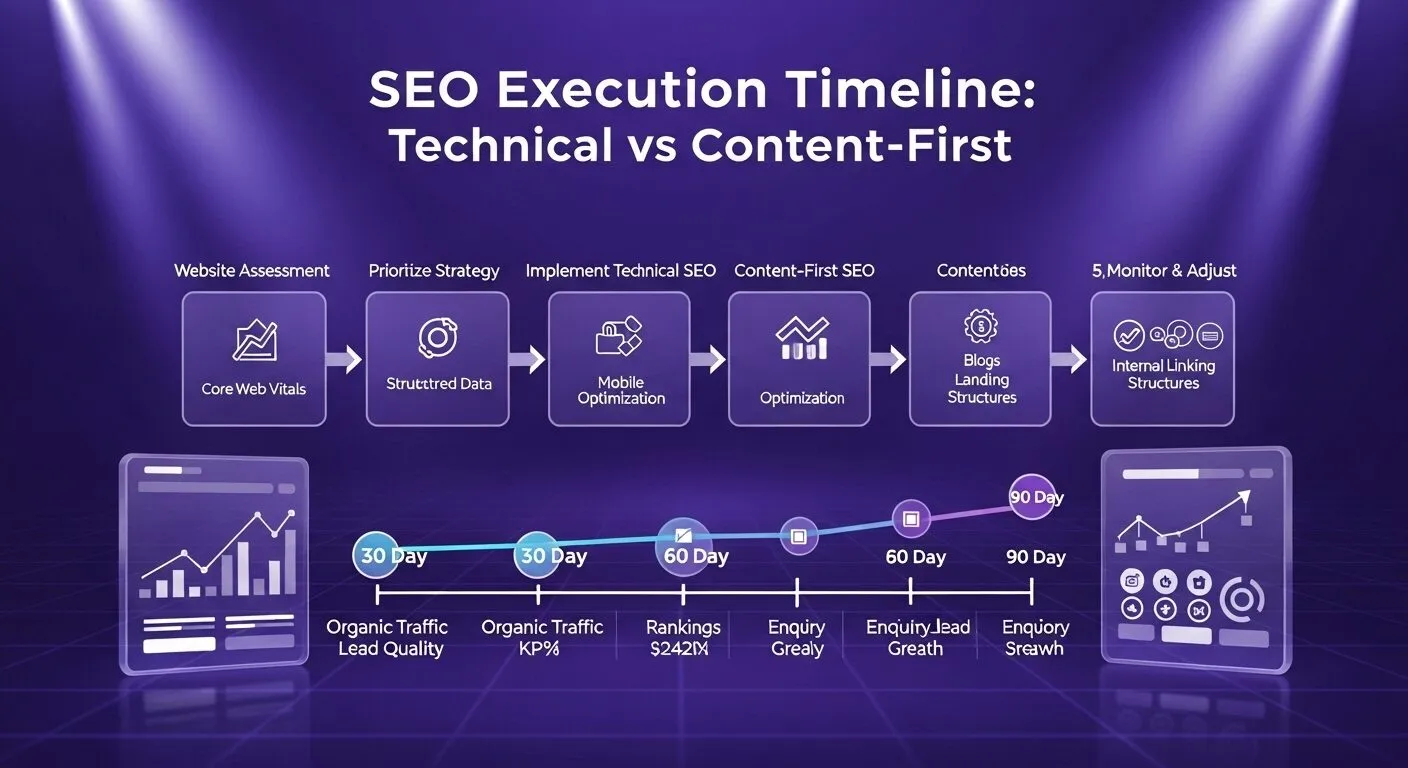
Main Differences at a Glance
| Area | Technical SEO | Content-First SEO |
|---|---|---|
| Main focus | Website access and performance | User value and relevance |
| Primary audience | Search engines and users | Users and search systems |
| Core question | Can the page be crawled and indexed? | Should this page be selected as the best answer? |
| Work type | Site structure, code, speed, schema, indexing | Research, writing, topic depth, examples, trust |
| Main tools | Search Console, PageSpeed Insights, Lighthouse, Screaming Frog | Search Console, keyword tools, content briefs, analytics |
| Risk if ignored | Pages may not be found or understood | Pages may be indexed but not chosen |
| Best owner | Developer, technical SEO, strategist | SEO strategist, writer, editor, subject expert |
The Eligibility vs Selection Model
The easiest way to understand the relationship between these two approaches.
Technical SEO creates eligibility
Content-first SEO creates selection
A page cannot rank if search engines cannot access it. That is the eligibility problem.
A page may still fail to rank if it is thin, generic, outdated, unclear, or less useful than competing pages. That is the selection problem.
The 6 Layers of Search Performance
Every page must pass through six layers before it can drive real business value.
1 Discovery
Search engines need to find your page through links, sitemaps, or other crawl paths.
Technical SEO supports this through XML sitemaps, internal links, clean URLs, and crawlable navigation.
2 Crawling and Rendering
Search engines need to load the page and process its HTML, CSS, JavaScript, images, and links.
Technical SEO supports this through fast loading, accessible resources, mobile-friendly design, and clean rendering.
3 Indexing
Search engines need permission and a clear signal that the page should appear in search results.
Technical SEO supports this through indexable pages, correct canonical tags, clean metadata, and no accidental noindex tags.
4 Understanding
Search engines need to understand the page topic, entities, relationships, and purpose.
Both approaches support this — structured data, semantic HTML, headings, internal links, and clear writing all help.
5 Selection
Search systems compare your page with other pages answering the same query.
Content-first SEO supports this by giving the user a better answer, clearer explanation, stronger examples, and more useful next steps.
6 Conversion
After the visit, the page should help the reader act.
Content-first SEO supports this through clear calls to action, service relevance, proof, trust signals, and page flow.
Why Technical SEO Matters
Technical SEO removes barriers between your website and search engines. Strong content can still underperform if:
Especially critical for:
Many SMEs lack in-house technical SEO expertise, making professional support essential for budget efficiency. If you need help fixing these foundational issues, explore our SEO Services in Mysore for hands-on technical implementation.
Why Content-First SEO Matters
Ranking is not only about being technically accessible. Search systems need evidence that your page is useful. A page can be crawlable but still fail if:
Especially critical for:
For businesses in competitive markets, content-first SEO drives local leads by targeting region-specific search queries and building authority in your niche. Learn how our SEO Services in Bangalore can help implement these content strategies effectively.
Which Should Come First?
The right priority depends on your website's current condition.
| Situation | Start With | Reason |
|---|---|---|
| Pages are not indexed | Technical SEO | Content cannot rank if not indexed |
| Site is very slow | Technical SEO | Poor experience reduces performance |
| Site recently migrated | Technical SEO | Redirects, canonicals, indexing must be checked |
| Content is thin or generic | Content-first SEO | Page needs better usefulness and depth |
| Competitors have stronger guides | Content-first SEO | Better answers are needed |
| Local pages not converting | Content-first SEO | Relevance, proof, trust need improvement |
| Ecommerce filters create duplicates | Technical SEO | Crawl waste and duplication must be controlled |
| Blog traffic is flat | Content-first SEO | Topic gaps and intent mismatch may be the issue |
| Ranking dropped after redesign | Technical SEO first | Structure, metadata, redirects may be broken |
| Traffic exists but leads are weak | Content-first SEO | Page may not match buyer intent |
How They Work Together
Not competing strategies — two halves of the same search problem.
A Service Page
Needs technical SEO to load quickly, use a clean URL, have valid schema, and be indexable.
Needs content-first SEO to explain the service, answer buyer questions, show proof, compare options, and guide the user toward action.
A Blog Article
Needs technical SEO to be linked from related content, included in the sitemap, and not blocked from indexing.
Needs content-first SEO to answer the query better than competitors, include examples, explain causes and outcomes, and give a useful checklist.
An Ecommerce Category Page
Needs technical SEO to control faceted URLs, canonical tags, pagination, and crawl paths.
Needs content-first SEO to include useful category copy, buying guidance, FAQs, comparison details, and internal links to related products.
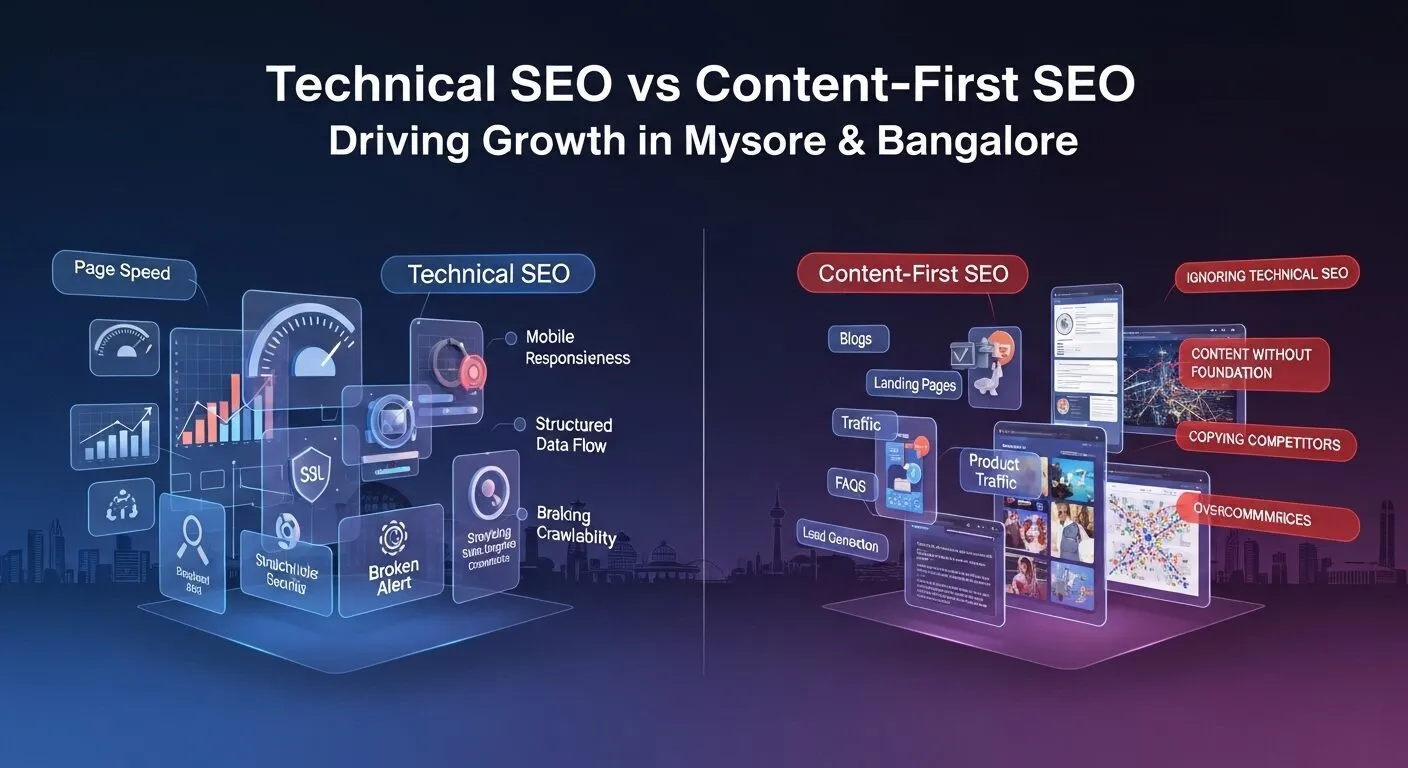
Mechanism: Cause → Process → Outcome
A website wants to rank for a competitive query, but search systems need to access the page and judge its usefulness.
Technical SEO removes access barriers. Content-first SEO improves relevance, trust, and usefulness.
The page becomes easier to crawl, easier to understand, more likely to satisfy the user, and more likely to earn rankings, snippets, AI citations, and conversions.
Technical SEO Checklist
Run through this before scaling content production.
| Check | Pass / Fail |
|---|---|
| Important pages are indexable | |
| Sitemap includes key URLs | |
| Robots.txt does not block important sections | |
| Canonical tags point to correct URLs | |
| Redirect chains are minimized | |
| Site works well on mobile | |
| Core Web Vitals are monitored | |
| HTTPS is active across the site | |
| Broken internal links are fixed | |
| Key pages reachable via internal links | |
| Structured data is valid where useful | |
| JavaScript content can be rendered | |
| Duplicate pages are controlled | |
| Old URLs redirect correctly after migration |
Content-First SEO Checklist
Run through this before publishing or updating any page.
| Check | Pass / Fail |
|---|---|
| Page answers the main query directly | |
| Important terms are clearly defined | |
| Content matches the search intent | |
| Headings are specific and useful | |
| Includes examples or scenarios | |
| Adds original insight | |
| Avoids repeating only common advice | |
| Includes internal links to related pages | |
| Includes FAQs with direct answers | |
| Easy to scan and navigate | |
| Includes trust signals where relevant | |
| Conclusion helps user decide next step |
SEO Triage Scorecard
Score each area from 1 to 5.
| Category | Score |
|---|---|
| Crawlability | /5 |
| Indexability | /5 |
| Page speed and usability | /5 |
| Mobile experience | /5 |
| Internal linking | /5 |
| Content depth | /5 |
| Search intent match | /5 |
| Topic coverage | /5 |
| Original insight | /5 |
| Conversion clarity | /5 |
How to Read the Score
Common Mistakes
1 Publishing More Content Without Fixing Indexing
More content cannot solve an indexing problem. If search engines cannot find or index your pages, adding more only increases waste. Fix crawl and index issues before scaling content production.
2 Over-Optimizing Technical Elements While Ignoring Content Quality
Perfect Core Web Vitals scores and valid schema will not help if the page content is thin, generic, or unhelpful. Technical excellence without content value leads to indexed but invisible pages.
3 Treating Technical and Content SEO as Separate Projects
When teams work in silos, technical changes can break content structure, and content updates can introduce technical issues. SEO works best when both disciplines are coordinated from the start.
4 Ignoring Content After Publishing
Content-first SEO is not a one-time task. Competitors update their pages, search intent shifts, and new questions emerge. Without regular audits and updates, even strong pages lose ground over time.
5 Focusing Only on Rankings, Not on Conversion
Rankings without conversions are a partial victory. Content-first SEO should always consider what the user should do after reading — contact, buy, subscribe, or take the next step.
Frequently Asked Questions
You may get pages indexed, but they are unlikely to rank competitively. Search systems compare your page against others answering the same query. Without strong, useful content, there is little reason for search engines to select your page over competitors.
Only if your site is already technically sound. If pages have indexing issues, slow speeds, or crawl barriers, even the best content may not perform. Technical SEO removes the floor; content builds the ceiling.
Technical fixes like resolving noindex tags, fixing broken links, or improving page speed can show results within days to weeks. Content-first SEO improvements typically take 4 to 12 weeks to show measurable ranking changes, depending on competition and crawl frequency.
Start with technical SEO. Ensure the site is crawlable, indexable, fast, and mobile-friendly. Then begin building content with a clear strategy. Launching content on a technically broken site wastes time and resources.
No. AI can help produce content faster, but the principles of content-first SEO — intent matching, depth, originality, trust, and conversion clarity — still apply. AI-generated content that is generic or repetitive will still underperform against well-crafted, expert-driven pages.
Use the SEO Triage Scorecard above. If your technical categories — crawlability, indexability, page speed, mobile experience, and internal linking — all score 3 or above, your technical foundation is solid enough to shift focus to content-first SEO.
Both Matter. The Question Is When.
Technical SEO vs Content-First SEO is not an either/or choice. Both are essential and interdependent: technical SEO provides the foundation, while content-first SEO drives visibility, leads, and growth. Businesses that implement both strategically — while monitoring results and aligning with local search behavior — are best positioned to outperform competitors.
Fix technical barriers first. Then invest in content that genuinely helps your audience. That is the order that produces lasting rankings and real business results.