Sri Manjunatha Electricals & Electronics operates in a market where one qualified enquiry can be far more valuable than a large number of casual website visits. Electrical contracting, HT/LT work, BESCOM-related services, commercial electrical projects, security systems and smart automation are high-consideration services. Prospects usually search because they have a specific project, approval requirement, installation need or electrical problem to solve.
That makes Google Search a strong acquisition channel, but it also means campaign quality matters. Broad terms such as “electrician” can attract low-value residential queries, job seekers, DIY searches or users looking for products instead of contracting services. Aspire Digital Solutions therefore approached the account around commercial intent, service segmentation and measurable conversion actions.
The supplied Google Ads report shows 2.84K clicks from 31.8K impressions, ₹200K in total spend and ₹248 average cost per conversion. The screenshot covers a long account view through September 12, 2026. Rather than treating traffic volume as the main result, the campaign was optimized around the cost of generating a tracked action from relevant search demand.
Electrical services cover a wide range of intent. A homeowner may search for a minor repair. A builder may need electrical work for an apartment project. A commercial property may require HT/LT installations, panels or cabling. A business may need CCTV, networking or smart automation. A project team may search for BESCOM-related approvals and electrical liaison support.
If all of these users are mixed into one generic campaign, the advertiser loses control. Broad keywords can generate impressions and clicks while hiding whether the traffic matches the work the business actually wants.
Sri Manjunatha Electricals publicly presents services including HT/LT electrical works, BESCOM-related work, industrial and commercial electrical services, security systems, networking and smart automation. Aspire's paid-search strategy therefore needed to distinguish high-value service intent from generic electrical browsing.
The supplied screenshot shows 31.8K impressions and 2.84K clicks. This means the campaigns were generating substantial exposure among search users, but clicks alone were not the optimization goal.
For a contractor, the value of a click depends on what the user needs. A search for “HT electrical contractor Bangalore” may represent a very different commercial opportunity from “how to fix switch at home.” Campaign structure needs to reflect that difference.
Search campaigns can be organized around service clusters such as HT/LT work, commercial electrical contracting, BESCOM-related services, smart automation, CCTV and other relevant offerings. Ads can then speak directly to the service rather than using one generic message for every query.
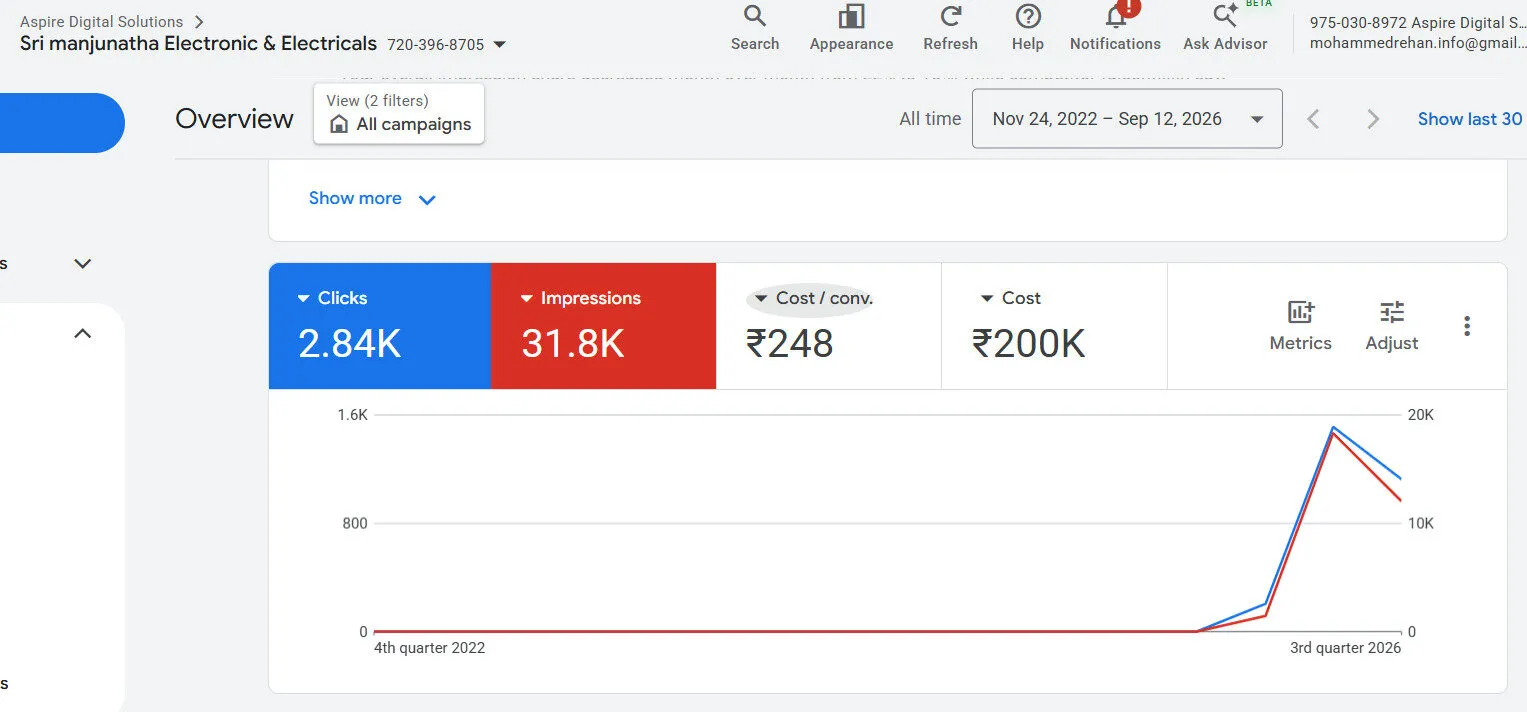
The supplied report shows ₹200K total cost and ₹248 average cost per conversion. For a high-value contracting business, this is a more useful platform metric than CPC alone because it connects spend with a tracked action.
That action could represent a call, enquiry form or another configured conversion event. The source evidence does not show completed project value or signed contracts, so the case study does not claim that every conversion became a customer.
This distinction is important. A Google Ads conversion is a marketing event. A project win is a sales outcome. The strongest reporting connects both systems where CRM data is available, but until then the case study should stay with what the platform actually proves.
A mature electrical contractor account benefits from splitting very different types of work. Commercial and industrial terms may need different budgets, ad copy and landing pages from domestic work. BESCOM-related searches can have their own intent. Smart-home or CCTV enquiries may require another message entirely.
Segmentation provides several advantages. First, budget can be directed toward the services the business wants to grow. Second, irrelevant searches are easier to identify. Third, ad copy can use terminology that matches the user. Fourth, landing pages can explain the relevant process instead of forcing every visitor through one general page.
This is especially important for project-based businesses where lead quality can vary dramatically.
Electrical keywords can trigger many unrelated searches: training courses, jobs, electrical products, wiring diagrams, DIY tutorials, exam questions or supplier queries. Even service terms can be too broad if the business wants larger commercial projects rather than small household work.
Search-term reviews help identify these patterns. Irrelevant themes can be excluded with negative keywords. Strong themes can be moved into dedicated ad groups or campaigns. Search language can also reveal how customers describe services, which can improve both ad copy and SEO content.
Over time, this process makes the account more intentional. Instead of buying traffic around “electrical” as a broad concept, the advertiser pays for searches that better match the business model.
Contractor lead generation should match the real service area. Geographic settings can be refined around Bangalore and other relevant Karnataka locations depending on the company's operational coverage.
Location performance can also be reviewed over time. If certain areas consistently generate useful enquiries, they may justify stronger bidding or dedicated landing pages. If areas create repeated low-quality enquiries, budget can be reduced or targeting tightened.
For high-value project work, this geographic discipline is often more important than maximizing total traffic.
A search ad can attract the right user, but a generic landing page can still lose the enquiry. Electrical project prospects may want to understand service scope, licensing, project experience, industries served, approval support, safety approach and contact process before they call.
Landing pages should therefore connect the keyword with specific proof. A user searching for HT/LT work should see those capabilities immediately. A user searching for BESCOM services should understand the relevant assistance. A commercial project prospect should not have to search the site to confirm that the company handles larger electrical work.
Clear pages improve conversion quality because they help users self-qualify before submitting an enquiry.
Electrical ads need to communicate competence without becoming unreadable. The most effective copy usually combines the service, location and a practical CTA. Where credentials or capabilities are used, they should be accurate and supportable.
Different campaigns can test language around contractor type, project scope, response time, consultation or quotation requests. The objective is to match the user's intent, not to make unsupported “best” or “number one” claims.
This approach also aligns with long-term SEO quality. The same service language used in ads can inform landing-page headings and FAQ content, creating a more consistent search journey.
All performance figures above come from the supplied Google Ads screenshot. The report shows paid-search traffic, spend and cost-per-conversion data. It does not include verified project revenue, signed-contract value, ROAS or a completed-project count.
Many contractor businesses evaluate paid advertising only by the number of calls or leads they receive. That is a start, but project-based services need another layer: relevance.
Ten generic enquiries for small work may be less valuable than one qualified commercial project enquiry. The campaign therefore needs to shape who clicks, what they see after the click and which conversion action is measured.
Google Ads is particularly useful when potential clients already know what they need. A builder searching for an electrical contractor, a business searching for HT/LT work or a property team looking for BESCOM support is expressing a specific need. The account's job is to make the business visible at that exact moment and remove enough friction for the user to enquire.
That is why service segmentation, search-term control and conversion measurement are more important than chasing the highest impression count.
Aspire managed Google Search campaigns around electrical service intent, with an emphasis on campaign segmentation, search-term control, local relevance and conversion-focused optimization.
The supplied screenshot shows 2.84K clicks, 31.8K impressions, ₹200K total cost and ₹248 average cost per conversion.
No. It is the Google Ads cost-per-conversion metric shown in the report. A conversion may be a call, form or other tracked action. The source does not include verified signed-project data.
They can attract users looking for small residential fixes, jobs, courses, products or DIY information. A contractor seeking higher-value project work needs stronger intent filters and negative keywords.
Queries that describe the actual service—such as commercial electrical contracting, HT/LT work, BESCOM-related services or other supported specialist work—can indicate stronger fit than generic electrical searches. Exact keyword choices should still be based on search-volume and lead-quality data.
Yes, but conversion tracking should reflect the real journey. The ad may generate an enquiry today while the project is qualified and closed later. Connecting ad data with CRM outcomes gives the most complete picture when available.
Aspire Digital Solutions provides SEO, Google Ads, Meta Ads, website development, social media marketing and performance-marketing services for businesses across multiple industries.
The agency's approach is built around connecting digital visibility with commercial intent.
For SEO projects, that can include technical SEO, on-page optimisation, search-intent research, content strategy, internal linking, local SEO, authority development and ongoing performance analysis.
For paid acquisition, Aspire works across search and social channels with campaign structures designed around the services, products and locations relevant to each business.
The case studies above document the reported performance of individual campaigns.
Results from one project should not be interpreted as a guarantee that another website or advertising account will achieve the same outcome.
Competition, market demand, budget, website condition, authority, offer quality, conversion experience and campaign duration can all affect performance.
Case studies reviewed by: Aspire Digital Solutions
Services represented: SEO, Google Ads and Meta Ads
Evidence used: Supplied SEO analytics, campaign reports, Google Ads data and client-specific performance screenshots