trending_up

...

...

ads_click

...

...

Premium Agency

Premium Services Portfolio Bidding Strategy Explained

We help businesses scale with data-driven strategies and world-class design.

Get Started rocket_launch
check

Request Received!

We've successfully logged your details. Our CRM team will reach out to you shortly.

Google Ads Feature

Portfolio Bidding

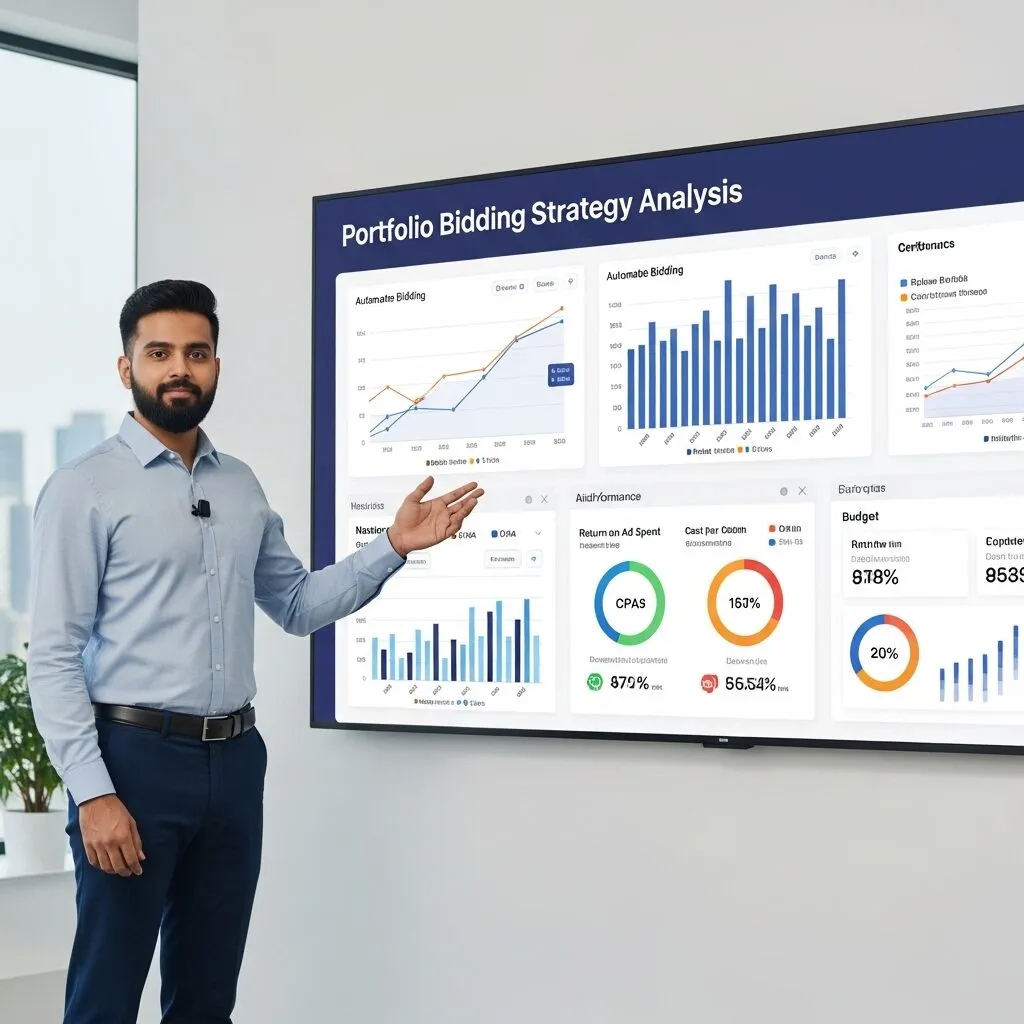
Portfolio bidding is a Google Ads feature that groups multiple campaigns, ad groups, or keywords under a single automated bidding strategy.

psychology

Dynamic Optimization

It uses machine learning to dynamically adjust bids and allocate budgets across campaigns, optimizing for conversions, ROAS, or cost efficiency.

verified_user

Strategic Alignment

Its effectiveness depends on historical data, campaign alignment, and accurate conversion tracking to ensure precise algorithmic performance.

The Strategy Verdict

Success requires data-rich environments. By centralizing automated bidding across your portfolio, you allow Google's machine learning to find the most efficient path to conversions across multiple campaign sets.
Bidding Strategy Audit

Top 7 Reasons Portfolio Bidding May Underperform

01

Insufficient historical data

Algorithm cannot accurately predict bid adjustments without a deep pool of historical performance data.

02

Misaligned campaign objectives

Conflicting goals within grouped campaigns reduce the optimization efficiency of the shared strategy.

03

Inaccurate conversion tracking

Optimization relies on unreliable performance signals if conversion pixels or events are incorrectly configured.

04

Excessive budget fragmentation

Low-performing campaigns may consume disproportionate spend, diluting the impact of your total budget.

05

Short campaign duration

Limited learning periods prevent stable algorithm behavior and long-term performance gains.

06

Overly restrictive bid caps

Algorithm lacks the necessary flexibility to adjust and capture peak performance auctions when caps are too low.

07

Ignoring seasonal or local variations

Market fluctuations and local trends are not reflected in automated bids, missing high-intent opportunities.

Core Explanation / Understanding Portfolio Bidding

Optimizing Portfolio Bidding

Portfolio bidding centralizes automated bidding across campaigns using strategies like Target CPA or Target ROAS. It adjusts bids based on real-time auction signals, historical performance, and campaign-level goals.

  • Core Limitation: Requires sufficient conversion volume (≥20 per campaign per month) to stabilize algorithm predictions.
  • Functional Scope: It cannot correct creative, landing page, or targeting issues; it optimizes the bid within your existing funnel constraints.
  • Time Sensitivity: Short-term campaigns (<30 days) show minimal optimization effect as the machine learning model needs time to iterate.

Strategic Components:

Includes campaign selection and grouping, conversion or value-based targets, budget allocation limits, and optional bid caps/floors.

Bidding Intelligence
Automated portfolio strategies leverage Google’s cross-campaign data to allocate budget where conversion probability is highest in real-time.
Data Volume Algorithm Learn
Diagnose Portfolio Bidding Challenges

Diagnose Portfolio Bidding

Follow this 6-point clinical audit to identify friction points in your automated portfolio strategies.

  • 01
    Audit Conversion Tracking Verify that all campaigns within the portfolio have accurate conversion tags and measurable outcome signals firing correctly.
  • 02
    Segment Campaigns by Goal Ensure the group includes only campaigns with perfectly aligned objectives to prevent conflicting algorithmic signals.
  • 03
    Review Historical Data Confirm that each individual campaign has provided sufficient conversion density for the machine learning model to stabilize.
  • 04
    Analyze Budget Allocation Identify if low-performing campaigns are consuming a disproportionate share of the daily spend, starving top performers.
  • 05
    Evaluate Bid Caps Confirm that restrictive bid limits are not choking the algorithm's flexibility to win high-value auctions during peak intent.
  • 06
    Monitor Seasonal Trends Adjust strategies for regional competition and peak demand periods where automated bids may need manual guidance.
Strategic Requirement: Measure performance weekly. Track CPA, ROAS, and conversion volume at the portfolio level to ensure long-term efficiency gains.
Optimization Strategy

Types of Keyword Intent
That Affect Results

Understanding how search intent drives algorithmic decision-making.

01

Informational

Search Context

Users seek knowledge; low conversion likelihood.

Bidding Impact: Portfolio bidding may deprioritize these unless engagement is a goal.
02

Commercial Investigation

Search Context

Users compare options; moderate conversion likelihood.

Bidding Impact: Optimizing for clicks and conversions improves efficiency.
03

Transactional

Search Context

Users intend to purchase; high conversion likelihood.

Bidding Impact: Portfolio bidding favors these when optimizing CPA or ROAS.
04

Navigational

Search Context

Users seek a specific brand or site; low optimization impact.

Bidding Impact: Including these can skew revenue-focused metrics.

Common Mistakes and
Why Fixes Fail

Strategic misalignment at different stages of the customer journey often leads to performance breakdown:

  • Awareness Stage: Broad reach campaigns in revenue-focused portfolios reduce cost-efficiency.
  • Consideration Stage: Ignoring mid-funnel signals or audience segmentation misleads bid adjustments.
  • Decision Stage: Applying portfolio bidding to short-term promotions prevents algorithm learning and distorts metrics.

Cluster Expansion –
Supporting Subtopics

  • Shared Budgets in Google Ads – How pooling budgets affects portfolio performance.
  • Target CPA vs. Target ROAS – Differences, trade-offs, and data requirements.
  • Conversion Tracking Best Practices – Accuracy, multi-step tracking, and offline conversions.
  • Portfolio Bidding for Multi-Channel Campaigns – Search, Display, YouTube, Performance Max.
  • Bid Cap Strategies and Pitfalls – Optimal ranges and over-constraining.
  • Seasonal Adjustment in Portfolio Bidding – Handling peak demand and local events.
  • Low-Volume Campaign Optimization – When individual bids outperform portfolios.
  • Portfolio vs. Campaign-Level Reporting – How metrics aggregate and mislead.
  • Cross-Campaign Learning Curves – Understanding algorithm stabilization time.
  • Portfolio Bidding for SMEs – Cost-efficient setup for small budgets.
  • Edge Cases: Contrarian Portfolio Strategies – Combining different objectives effectively.
  • AI-Powered Bid Insights – Using external analytics to supplement Google automation.

Strategic Ecosystem: Each subtopic can become a standalone supporting article linking back to this cluster hub. High data integrity ensures these components work in unison for maximum ROI.
Google Ads Portfolio Bidding Subtopics
Strategic Analysis

Portfolio vs. Individual
Campaign Bidding

A technical breakdown of how centralized automation compares to granular manual control.

Feature
Portfolio Bidding
Individual Bidding
Optimization
Cross-campaign

Aggregates learning across campaigns for efficiency

Per campaign

Focused strictly on single-funnel metrics

Budget Allocation
Dynamic

Shifts budget to high-performing campaigns automatically

Fixed

Hard limits per campaign regardless of performance spikes

Bid Control
Automated

Machine learning improves general efficiency

Manual

Gives granular, manual control over every auction

Learning Time
Moderate

Requires historical data for algorithm training

Low

Adjustments take effect without data ramp-up

Risk Profile
Medium

Misaligned campaigns can dilute performance

High

Increased risk of wasted spend without daily monitoring

Portfolio Bidding Strategy
Knowledge Base Portfolio Bidding FAQ
Expert Insights

Frequently Asked Questions

Navigate the complexities of centralized bidding strategies with these data-backed expert answers:

01

Can portfolio bidding reduce wasted ad spend?

Yes, it reallocates budget to higher-performing campaigns. Effectiveness depends on tracking accuracy and sufficient conversion data.

02

How much historical data is needed?

Minimum 20 conversions per campaign per month. Insufficient data reduces machine learning accuracy.

03

Is portfolio bidding suitable for single-campaign advertisers?

No, its benefits rely on cross-campaign optimization. Single campaigns gain limited advantage.

04

Can local or seasonal trends impact performance?

Yes, unaccounted fluctuations can mislead automated bids. Adjusting campaigns for local trends improves outcomes.

05

How to measure portfolio success?

Track CPA, ROAS, conversion volume, and budget distribution at portfolio level weekly. Avoid evaluating campaigns individually.

06

What are common implementation pitfalls?

Misaligned objectives, restrictive bid caps, poor conversion tracking, and short campaign durations often cause failure.

07

Can portfolio bidding replace all manual optimization?

No, human oversight remains necessary for creative adjustments, audience segmentation, and strategy alignment.

Final Verdict
Portfolio bidding centralizes campaign optimization and reallocates budgets dynamically. It improves cost efficiency when campaigns have aligned goals and sufficient conversion data.

Scale with Algorithmic
Precision.

Success requires accurate tracking, proper campaign selection, and consistent performance monitoring across all included campaigns. By aligning iterative adjustments with machine learning signals, we transform portfolio spend into a high-potential revenue engine.

Accurate Tracking
Goal Alignment
Dynamic Allocation
Consistent Monitoring