How to Structure SEO Work:
A Practical Operating System for Sustainable Organic Growth
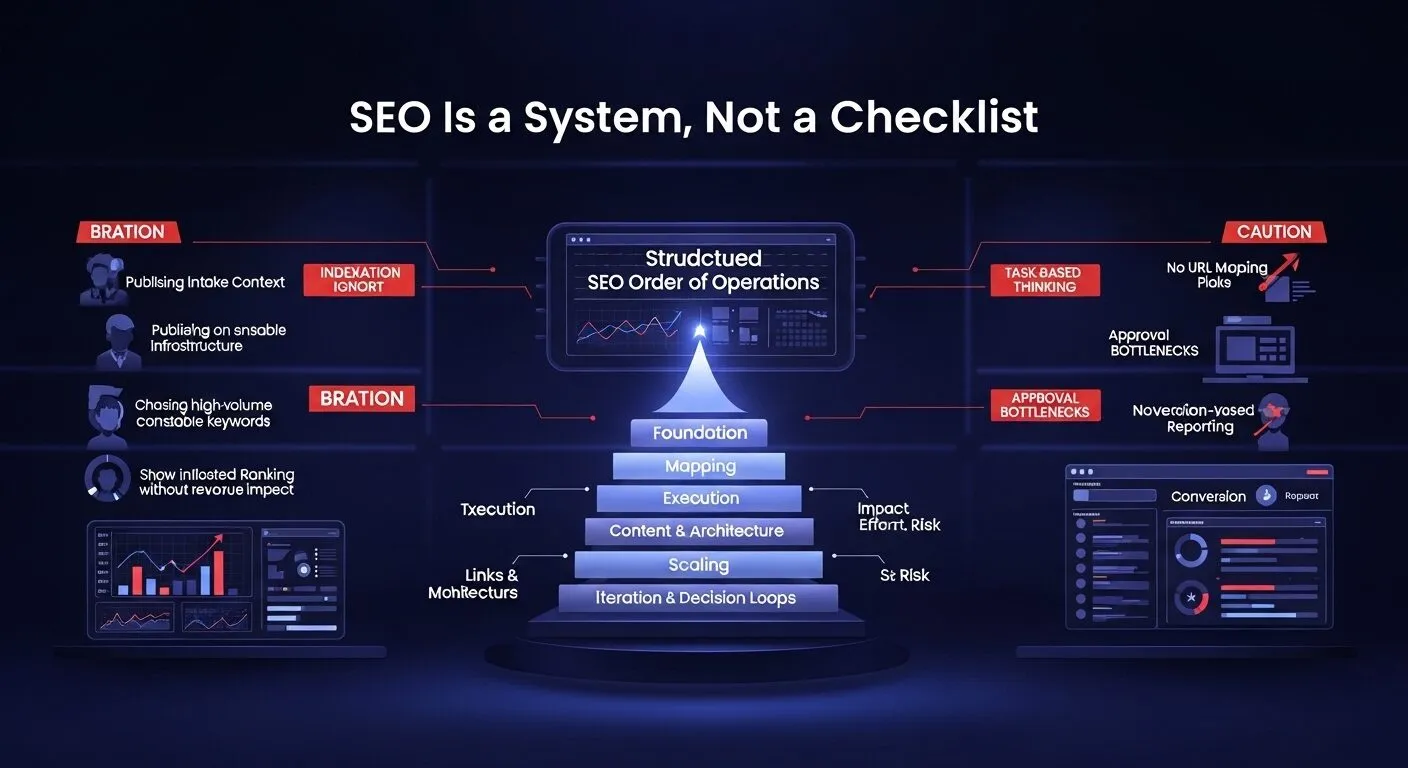
SEO Services should be structured as a repeatable operating system, not a random list of tasks. A strong SEO structure includes clear business goals, technical SEO, content planning, authority building, task ownership, prioritization, execution cycles, and performance reporting. This helps teams improve rankings, traffic quality, conversions, and AI search visibility with less wasted effort.
What Does "Structuring SEO Work" Mean?
Structuring SEO work means organizing every SEO activity into a clear system. It defines what needs to be done, who owns it, why it matters, when it should happen, and how success will be measured.
SEO work usually fails when teams treat it as separate tasks:
A better structure connects SEO work into one operating system.
The goal is simple: make the website easier for search engines to access, easier for users to understand, and easier for the business to measure.
The 5-Layer Model for Structuring SEO Work
SEO work becomes easier to manage when it is divided into five layers.
| SEO Layer | Purpose | Main Owner |
|---|---|---|
| Strategy | Connect SEO to business goals | SEO lead or marketing head |
| Technical SEO | Make the site crawlable, indexable, fast, and usable | SEO specialist + developer |
| Content SEO | Build pages that answer real search intent | Content SEO + writer |
| Authority | Build trust through internal links, external mentions, expertise, and reputation | SEO lead + PR/content team |
| Measurement | Track what improves rankings, traffic, leads, and revenue | SEO analyst |
Each layer supports the next. Strategy sets direction. Technical SEO makes the site accessible. Content SEO answers demand. Authority improves trust. Measurement shows what is working. Businesses that want all of these elements managed together can work with Aspire Digital Solutions for a structured, data-driven SEO approach focused on long-term search growth.
Why SEO Work Needs Structure
SEO work is cross-functional. It touches marketing, writing, design, development, analytics, sales, and leadership.
Without structure, SEO teams face common problems:
A structured SEO workflow prevents these problems by turning SEO into a managed process.

Start With Business Goals, Not Keywords
SEO should not begin with keyword lists. It should begin with business goals.
A keyword is only useful if it can attract the right audience and support a measurable business outcome.
Before planning SEO work, answer these questions:
This prevents the team from chasing traffic that does not help the business.
Map SEO Work to Search Intent
Every SEO task should connect to user intent.
| Search Intent | User Wants | Best Page Type |
|---|---|---|
| Informational | Learn or understand | Guide, blog, explainer |
| Commercial | Compare options | Comparison page, buyer guide |
| Transactional | Take action | Service page, product page |
| Local | Find nearby provider | Location page, Google Business Profile |
| Support | Solve a problem | FAQ, help page, tutorial |
| Brand | Verify a company | About page, case study, review page |
Good SEO structure ensures every page has one clear intent. A page trying to serve too many intents often becomes weak for all of them.
Build a Clear SEO Ownership Model
SEO work slows down when everyone is involved but no one is accountable.
Use a simple ownership model.
| Role | Main Responsibility |
|---|---|
| SEO Lead | Strategy, prioritization, roadmap, reporting |
| Technical SEO | Crawlability, indexation, structured data, speed, site architecture |
| Content SEO | Keyword mapping, briefs, page optimization, internal links |
| Writer | Drafts useful content based on briefs and expert input |
| Developer | Implements technical fixes and page changes |
| Designer | Improves usability, layout, visuals, and conversion paths |
| Analyst | Tracks rankings, traffic, conversions, and business impact |
| Subject Expert | Adds accuracy, experience, examples, and expert review |
| Leadership | Confirms priorities, budget, and business goals |
The SEO lead does not need to do everything. The SEO lead must make sure the right work happens in the right order.
Create an SEO Work Roadmap
An SEO roadmap is a prioritized plan of work. It should not be a long wish list.
A useful roadmap includes:
A roadmap should be reviewed every month and rebuilt every quarter.
Use the SEO Priority Score
Not all SEO tasks deserve equal attention. A page with commercial value and technical risk should usually be fixed before a low-value informational blog.
Use this scoring model:
SEO Priority Score = Business Impact + Search Demand + Conversion Value + Technical Risk − Effort
Rate each factor from 1 to 5.
| Factor | Meaning |
|---|---|
| Business Impact | How much this task supports revenue, leads, or strategic growth |
| Search Demand | How many relevant searches exist |
| Conversion Value | How likely the page is to support leads or sales |
| Technical Risk | How badly the issue blocks crawling, indexing, UX, or performance |
| Effort | Time, cost, and complexity required |
The highest-scoring tasks should enter the next sprint.
The 90-Day SEO Work Cycle
SEO should run in cycles. A 90-day cycle is long enough to complete meaningful work and short enough to adapt.
Audit and Diagnose
Review:
The goal is to find the biggest blockers and opportunities.
Prioritize and Plan
Turn the audit into a ranked task list.
Group work into:
Assign owners and deadlines.
Execute
This is the production phase.
The team should:
Execution should be tracked weekly.
Measure and Improve
Review:
The cycle ends with decisions for the next 90 days.
How to Structure Technical SEO Work
Technical SEO work should focus on access, clarity, speed, and stability.
Core Technical SEO Tasks
| Task | Why It Matters |
|---|---|
| Crawlability check | Search engines must be able to access important pages |
| Indexation review | Important pages should be eligible to appear in search |
| Site architecture | Users and search engines need clear page relationships |
| Internal linking | Helps distribute authority and context |
| Core Web Vitals | Supports user experience and performance |
| Mobile usability | Most users and crawlers rely on mobile-first access |
| Canonical tags | Reduces duplicate-page confusion |
| Redirect management | Preserves equity and avoids broken paths |
| Structured data | Helps search engines understand page meaning |
| XML sitemap | Helps list important URLs |
Technical SEO should not be handled only after problems appear. It should be included before page launches, redesigns, migrations, and content scaling.
How to Structure Content SEO Work
Content SEO should be organized around search intent, entity coverage, and page purpose.
A strong content workflow looks like this:
What an SEO Content Brief Should Include
A content brief keeps writers, SEO teams, and experts aligned.
Include:
A weak brief creates generic content. A strong brief creates a page with purpose.
Structure SEO Work Around Topic Clusters
A topic cluster connects one main page with several supporting pages.
Example:
Main page: SEO Services
Supporting pages:
Each supporting page should link back to the main page when relevant. The main page should link to supporting pages that help the user continue learning or take action.
This creates a clear topic relationship for users and search systems.
How to Structure Internal Linking Work
Internal linking should not be random. It should support hierarchy, relevance, and user movement.
Use this framework:
| Link Type | Purpose |
|---|---|
| Parent to child | Main service page links to detailed sub-service pages |
| Child to parent | Supporting page links back to the main page |
| Sibling to sibling | Related pages link to each other when useful |
| Blog to service | Informational content supports commercial pages |
| Service to proof | Service page links to case studies, reviews, or examples |
| FAQ to main page | Support content sends users to deeper pages |
Every internal link should help the reader. Links added only for search engines weaken the page experience.
How to Structure SEO Work for AI Overviews and LLM Search
AI search systems prefer content that is clear, specific, and easy to extract.
Structure pages with:
Do not write only for AI systems. Write for people first, but make the information easy for machines to understand.
Diagnostic Checklist: Is Your SEO Work Structured Correctly?
Use this checklist to audit your SEO process.
| Question | Yes/No |
|---|---|
| Do all SEO tasks connect to business goals? | |
| Is there one owner for SEO strategy? | |
| Are technical tasks prioritized by impact? | |
| Does every content brief include search intent? | |
| Are subject experts involved in important pages? | |
| Is internal linking planned before publishing? | |
| Are old pages refreshed based on data? | |
| Are rankings connected to leads or sales? | |
| Is SEO reviewed in 90-day cycles? | |
| Are pages structured for AI answer extraction? |
If several answers are "No," the problem may not be SEO knowledge. The problem may be SEO operations.
Decision Matrix: In-House, Agency, or Hybrid SEO Work
| Situation | Best SEO Structure |
|---|---|
| Small website, limited budget | Founder or marketer + part-time SEO support |
| Growing business with content needs | In-house content owner + SEO consultant |
| Large site with technical issues | Technical SEO + developer + SEO lead |
| Competitive niche | Hybrid team with content, technical SEO, and authority work |
| Local service business | Local SEO owner + content support + review process |
| Ecommerce website | Technical SEO + product content + analytics |
| Enterprise site | SEO lead, technical SEO, content SEO, analyst, developers, agency support |
A hybrid model often works best because strategy stays close to the business while specialists handle complex execution.
Common Mistakes When Structuring SEO Work
Mistake 1: Starting With Blogs Instead of Strategy
Publishing more blogs will not fix weak positioning, poor site structure, or unclear business goals.
Mistake 2: Ignoring Technical SEO
Great content may underperform if important pages are hard to crawl, slow, duplicated, blocked, or poorly linked.
Mistake 3: Treating SEO as One Person's Job
SEO requires writers, developers, designers, analysts, and business decision-makers.
Mistake 4: Measuring Only Rankings
Rankings matter, but they are not enough. Track qualified traffic, leads, assisted conversions, and revenue impact.
Mistake 5: Creating Pages Without Internal Links
A page with no useful internal links is harder for users and search systems to place in context.
Mistake 6: Copying Competitor Structures
Competitor pages can show search expectations, but your content needs stronger examples, clearer answers, better expertise, and more useful decision support.
Edge Cases
New Website
Focus first on technical access, core service pages, brand trust, and a small number of strong informational pages.
Large Website
Prioritize crawl control, indexation quality, templates, internal linking, duplicate content, and content decay.
Local Business
Build service pages, location pages, Google Business Profile updates, review systems, local proof, and clear contact paths.
B2B Company
Map SEO content to long sales cycles. Use comparison pages, problem pages, industry pages, case studies, and educational guides.
Ecommerce Site
Focus on category pages, product schema, faceted navigation control, internal links, product content, and review quality.
Local Context: Structuring SEO Work for a Local Service Business
A local business should divide SEO work into five areas:
Example structure:
Local SEO work should prove relevance, location, service expertise, and trust.
Expert Commentary
The best SEO teams do not ask, "What keyword should we target next?" first.
They ask:
That shift changes SEO from activity to strategy.