Most SEO articles explain what SEO is. Very few explain how agencies actually structure SEO work when real clients, deadlines, budgets, and internal chaos are involved. This guide does exactly that. At Aspire Digital Solutions, we focus on practical, results-driven SEO frameworks tailored for growing businesses in competitive markets, ensuring strategy, execution, and measurable growth move in alignment.
Below is the real-world SEO workflow agencies use, based on how SEO is executed across:
This is not a checklist. It’s a decision-based workflow used in production.
Before we get into the framework, here’s why most SEO plans collapse after month one: Everything is marked “high priority,” strategy isn’t connected to capacity, and content runs in silos.
Clients expect traffic before foundations are fixed, and reporting shows metrics, not decisions. Real agencies structure SEO work to reduce risk first, then compound gains.

This is the actual order of operations used by experienced agencies. Skipping or reordering these steps is where SEO fails:
| Phase | Execution Pillar | Focus |
|---|---|---|
| Phase 1 | Client & Business Intake | Context First |
| Phase 2 | Technical Risk Audit | Stability Before Growth |
| Phase 3 | Search Demand & Opportunity | Strategic Mapping |
| Phase 4 | SEO Roadmap | Prioritization |
| Phase 5 | Execution Phase | Technical → Content → Authority |
| Phase 6 | Measurement & Reporting | Decision Loops |
| Phase 7 | Iteration | Scaling |
Agencies don’t start with keywords. They start with constraints.
SEO strategy for a local service business in Mysore is completely different from a national SaaS brand—even if keywords look similar. Agencies structure SEO work around business reality, not tools. Businesses investing in SEO Services in Mysore benefit from localized keyword targeting, Google Business Profile optimisation, and competition-aware strategies tailored specifically for the Mysore market.
What agencies deliberately delay: Micro-optimizations, over-engineered schema, non-impactful page speed tweaks. Rule: If Google can’t crawl, index, or trust the site, content won’t save you.
This is where most DIY SEO goes wrong. Agencies do opportunity mapping, including:
Output: Keyword clusters mapped to specific URLs. Clear distinction between Immediate wins, Medium-term plays, and Long-term authority topics. No keyword lives without a URL plan. Businesses investing in SEO Services in Bangalore follow this structured mapping approach to ensure every keyword aligns with a clear business objective and measurable growth target.
This is where SEO becomes operational. Agencies prioritize using 3 filters: Impact (traffic/conversions), Effort (realism), and Risk (what breaks if delayed?).
Example Logic: Fix indexation → before publishing content. Optimize existing pages → before creating new ones. Build authority → only after on-page intent is correct. This roadmap is time-based, not task-based.
Fix critical errors, improve site architecture, clean internal linking, and ensure clean indexing signals.
Optimize existing pages first, publish intent-matched content, build topic clusters, and strengthen links.
Digital PR, niche link acquisition, local citations, brand mentions, and review signals.
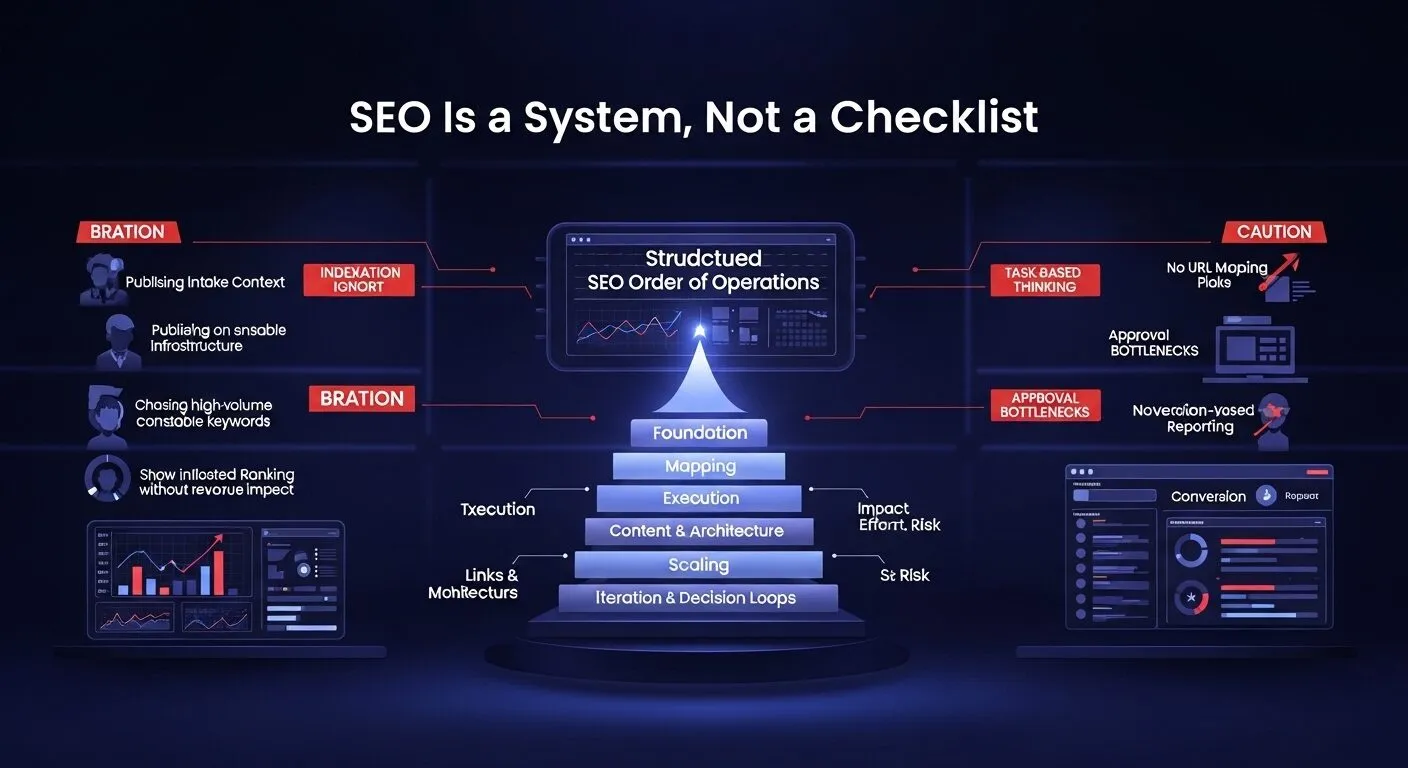
This is rarely discussed—but critical. Agencies intentionally avoid publishing content on broken sites, chasing high-volume keywords too early, over-reporting vanity metrics, and blind link building. SEO success is often about strategic omission.
Real SEO reporting answers: What changed? Why did it change? What do we do next? Metrics tracked:
Once foundations are stable, SEO becomes a system, not a project. We double down on converting pages, expand clusters, reduce paid reliance, improve CTR/UX, and refresh content before competitors do.
Agencies don’t confuse channels—but they integrate insights. Paid search data validates keyword value, AI tools speed up audits/optimization, and human judgment drives prioritization. How to Structure SEO Work is the foundation of sustainable rankings—strategy comes first, execution follows. SEO is structured first. Tools come second.
Yes. This structure reflects how SEO is executed across retainers, local SEO, national campaigns, and ecommerce projects.
Technical fixes take weeks; Content gains 2–4 months; Authority-driven growth takes 4–6+ months.
Yes—but simplified. The order matters more than the scale. Start with stability.
They serve different roles. SEO compounds over time. Paid validates and accelerates immediate intent.