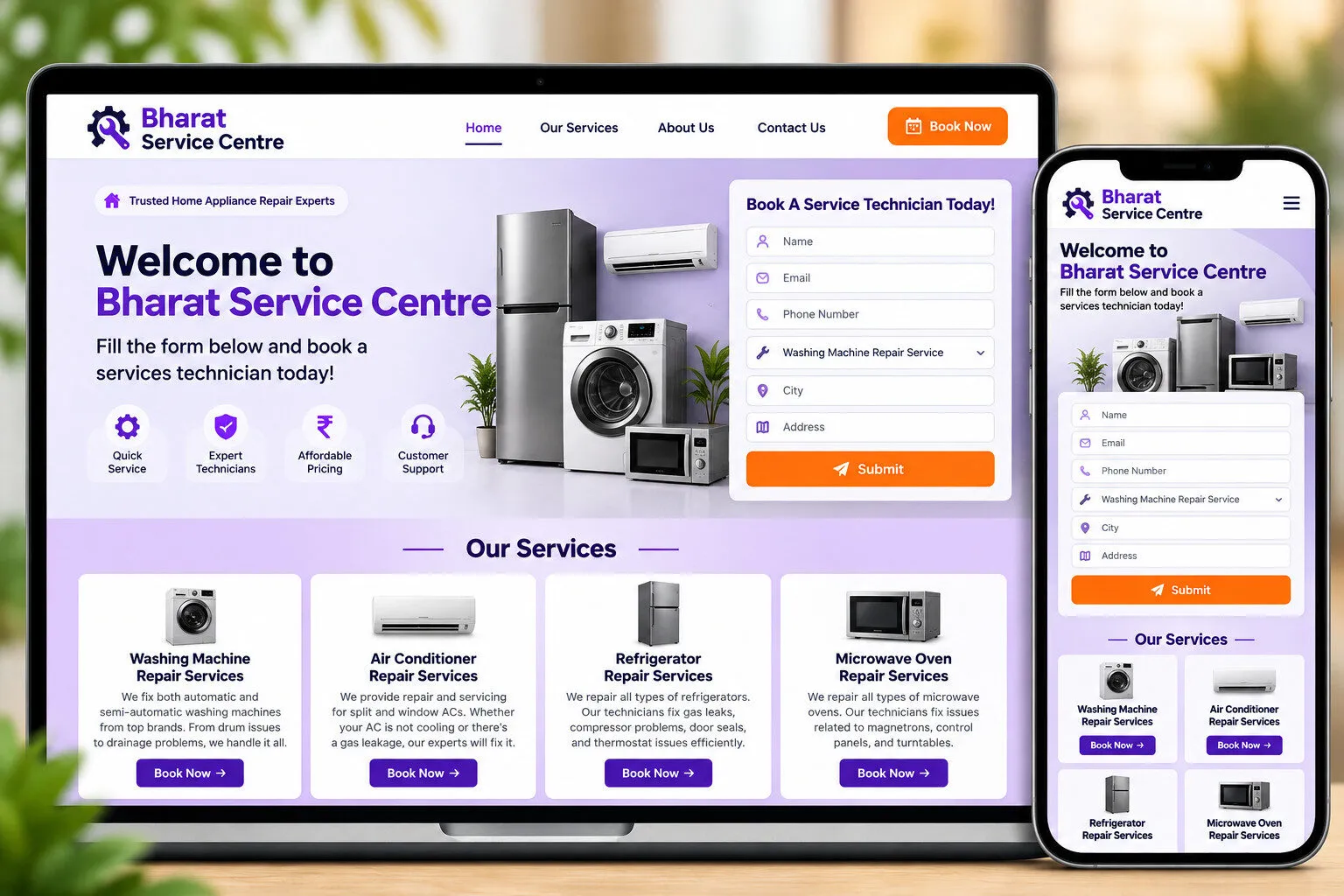
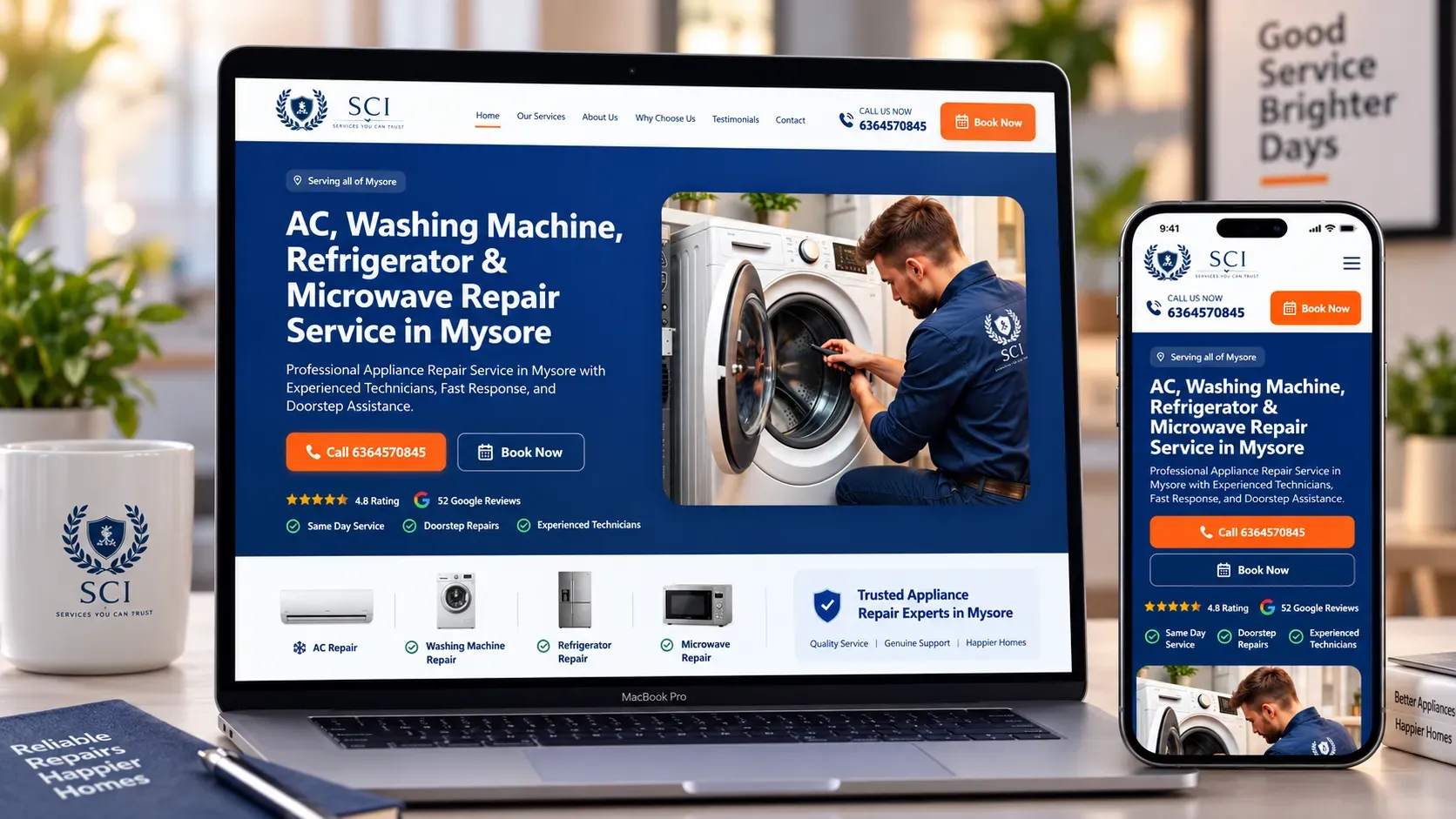
Bharat Services Bangalore competes in one of the most direct-response search environments: appliance repair. Customers usually search because something has stopped working and they want a provider quickly. That creates strong commercial intent, but it also creates a crowded auction where multiple local businesses compete for the same searches.
Aspire Digital Solutions managed the account around a simple principle: traffic is only useful when it produces a measurable service action. Search campaigns were therefore treated as a conversion system rather than a click-generation exercise.
The supplied Google Ads report shows 28.6K clicks, 6.01K conversions, ₹964K in spend and ₹160 average cost per conversion. The visible date range runs from November 24, 2022 to September 12, 2026, indicating a long-term account with enough volume for sustained search-term and conversion optimization.
Client website:
https://bharatservicecentre.online
Local appliance repair is not a category where users spend weeks researching. A broken refrigerator, washing machine or AC creates an immediate problem. That urgency is useful for paid search because it produces strong intent, but it also means every advertiser is trying to appear at the same decision point.
The account therefore has to answer several questions continuously. Which repair searches indicate a real service need? Which keywords are too broad? Which locations generate useful enquiries? Which appliance categories convert efficiently? Which searches suggest warranty support, spare parts or DIY research rather than a paid repair requirement?
Without that control, an account can accumulate clicks quickly and still fail to produce enough useful enquiries. Aspire structured the work around conversions so campaign decisions could be tied to user actions rather than traffic volume alone.
The supplied screenshot shows 28.6K clicks over the visible reporting period. At that scale, even small improvements in search relevance can materially affect cost. A weak keyword or poorly matched query can spend repeatedly; a strong query can become the basis for a dedicated ad group or landing page.
The account also recorded 6.01K conversions. This is the metric that gives the traffic context. The goal of a local service campaign is not to win the most clicks. It is to consistently turn high-intent searches into calls, forms, booking actions or other configured lead events.
By making conversion data central to optimization, the account can compare service categories and search themes based on their ability to produce action.
The Google Ads report shows ₹964K total cost and ₹160 average cost per conversion. Cost per conversion creates a practical benchmark for a lead-generation account because it links spend to the event the advertiser has defined as valuable.
It is important to interpret that number correctly. Platform conversions are not automatically the same as completed paid jobs. A conversion could be a call, a submitted form or another tracked action. The screenshot does not include CRM-confirmed revenue or job completion data. This case study therefore uses the exact Google Ads metric and does not inflate it into unsupported customer or revenue claims.

Repair searches contain useful intent signals. A query that names the appliance, problem and city can be much more valuable than a broad informational phrase. Campaign structure should make it possible to respond to those signals with relevant ad copy.
A washing machine repair user may be dealing with drainage, spinning or error-code issues. A refrigerator user may search because the appliance is not cooling. An AC user may want repair, servicing or installation. These are different needs even though they all sit under “appliance service.”
Separating them gives the advertiser more control over budgets, search terms and landing messages. It also makes performance reporting more useful because the team can see which category is generating conversions rather than looking only at one blended account total.
One of the most important tasks in Google Ads is not visible in a headline result: reviewing what people actually typed before the ad was shown.
Search-term analysis helps identify four things. First, high-intent phrases that should receive more focus. Second, irrelevant phrases that should become negative keywords. Third, new service or location themes that deserve dedicated campaigns. Fourth, language that should be reflected in landing-page copy because customers repeatedly use it.
This is especially important in repair advertising because terms can overlap with manufacturer support, warranty centres, spare-parts searches and DIY troubleshooting. An independent service business needs to avoid creating misleading expectations and should target users whose needs match the actual service model.
Local lead generation depends on both geographic targeting and message relevance. A user needs to understand whether the service is available in their area and whether the provider handles the appliance they are searching about.
Campaigns can be refined by location performance over time. Areas with strong conversion volume can justify more budget, while areas producing repeated low-quality traffic can be reviewed. The same principle applies to device, time of day and service category when enough data exists.
The account's scale makes those segmentation decisions possible. With tens of thousands of clicks, optimization can be based on patterns rather than isolated events.
A high-intent repair user generally wants clear information. The ad should communicate the relevant service, local availability and a direct next step. The landing experience should then make calling or submitting a request easy.
The strongest message is not necessarily the most aggressive claim. It is the message that accurately answers the user's need and reduces uncertainty. In local service advertising, trust can be damaged quickly by vague affiliation claims or information that does not match the actual service model.
For that reason, ad copy and landing pages should be written around verifiable service capabilities and transparent contact options.
The supplied report spans from November 24, 2022 through September 12, 2026. A long-running account is different from a short campaign test because it experiences changes in demand, competition, Google Ads automation and search behaviour.
Performance management therefore needs ongoing adjustments. Keyword bids and budgets may change. Search terms evolve. New campaign types may be tested. Landing pages are updated. Conversion tracking needs to stay accurate. What worked a year ago should not automatically be assumed to be the best structure today.
The value of long-term management is the accumulated knowledge from this cycle: launch, measure, exclude waste, expand what works, improve the landing path and repeat.
All performance figures come directly from the supplied Google Ads screenshot. The case study does not claim revenue, ROAS, completed repair jobs or customer count because those figures were not supplied.
The lesson is not that every repair business should expect the same ₹160 cost per conversion. Auction costs, location, competition, website quality, service categories and conversion setup vary. The useful part is the operating model.
Local paid search performs best when the account begins with customer intent, connects that intent to the correct service page and then measures a real next step. Once that system is in place, optimization becomes more disciplined. Decisions are based on which searches generate conversion actions rather than which keywords simply accumulate impressions.
That same framework applies to many high-intent local categories: repair services, clinics, contractors, professional services and other businesses where the customer searches because they need help now.
Aspire managed Google Ads as a conversion-focused local search system, using service-specific intent, query review, geographic relevance and ongoing optimization to generate trackable enquiries.
The supplied screenshot shows 28.6K clicks, 6.01K conversions, ₹964K total cost and ₹160 average cost per conversion.
The supplied filename references: https://bharatservicecentre.online
No such claim is made. The number is the Google Ads conversion count shown in the platform. Without CRM-confirmed booking and revenue data, it should not be presented as completed paid jobs.
CPC only measures the cost of traffic. Cost per conversion connects spend to a configured action, making it more useful for lead-generation decisions. Cheap clicks can still be poor value if they do not produce enquiries.
Regular search-term reviews, negative keywords, service segmentation, precise location settings, relevant landing pages and accurate conversion tracking are core controls. Lead quality feedback from the business should also be used where possible.
Aspire Digital Solutions provides SEO, Google Ads, Meta Ads, website development, social media marketing and performance-marketing services for businesses across multiple industries.
The agency's approach is built around connecting digital visibility with commercial intent.
For SEO projects, that can include technical SEO, on-page optimisation, search-intent research, content strategy, internal linking, local SEO, authority development and ongoing performance analysis.
For paid acquisition, Aspire works across search and social channels with campaign structures designed around the services, products and locations relevant to each business.
The case studies above document the reported performance of individual campaigns.
Results from one project should not be interpreted as a guarantee that another website or advertising account will achieve the same outcome.
Competition, market demand, budget, website condition, authority, offer quality, conversion experience and campaign duration can all affect performance.
Case studies reviewed by: Aspire Digital Solutions
Services represented: SEO, Google Ads and Meta Ads
Evidence used: Supplied SEO analytics, campaign reports, Google Ads data and client-specific performance screenshots