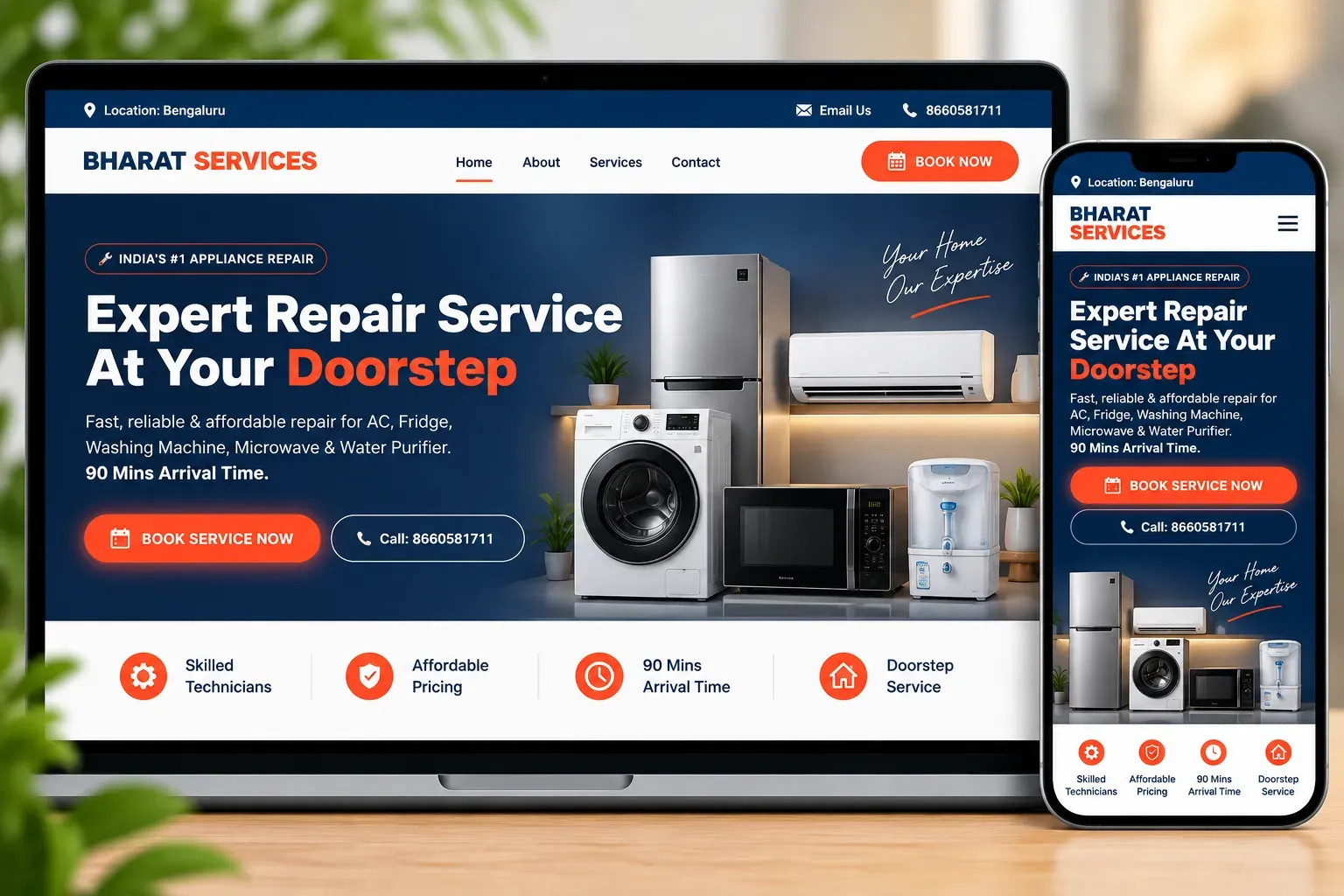
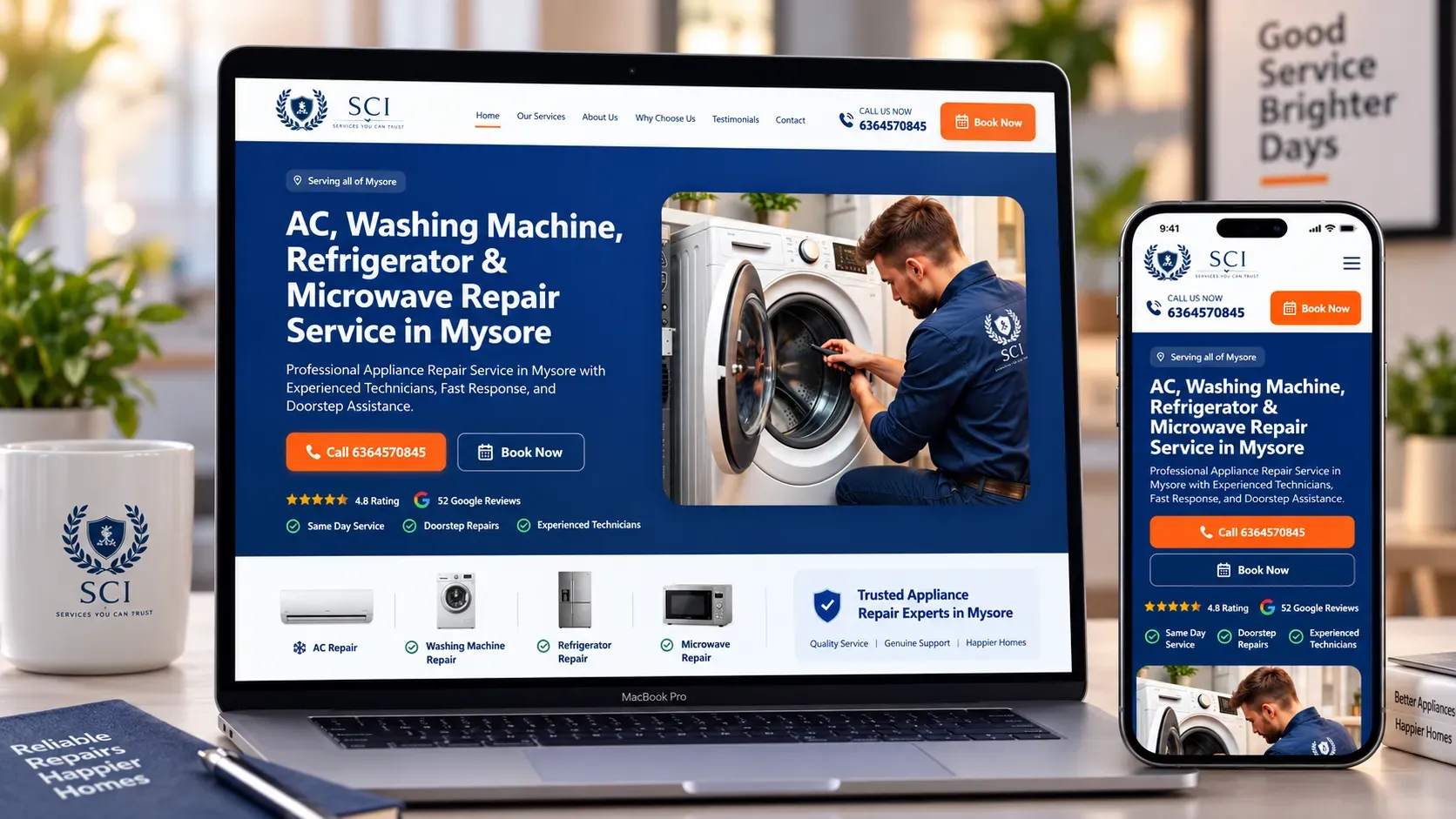
Bharat Appliance Services operates in a category where search intent is immediate. When a washing machine stops working, a refrigerator stops cooling, an AC fails, or a microwave needs repair, the customer is usually not browsing for inspiration. They are looking for a service provider who can respond quickly, explain the next step and take the booking.
That makes Google Search one of the strongest acquisition channels for appliance repair, but it also makes the market expensive and highly competitive. Multiple providers may bid on the same repair terms, users frequently compare businesses in minutes, and broad keywords can spend heavily on irrelevant or low-value searches. Aspire Digital Solutions built the campaign around service intent, local relevance and conversion tracking instead of treating every click as equal.
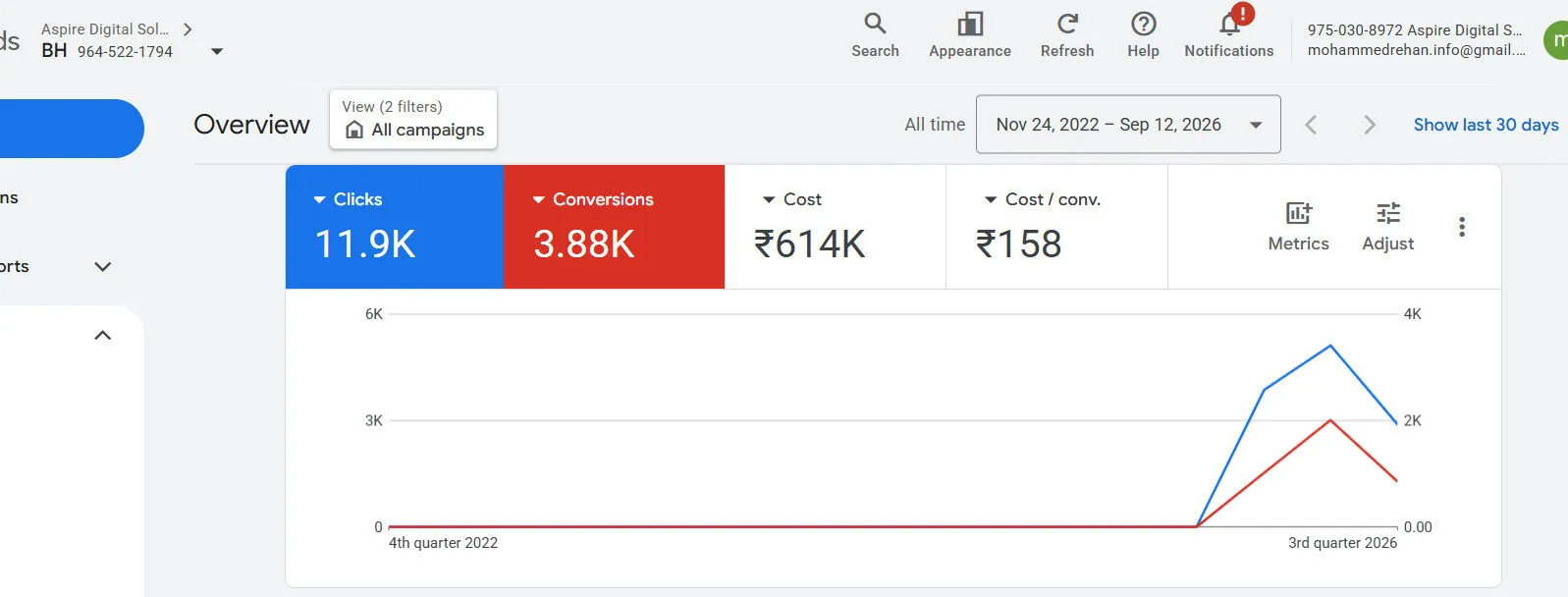
The supplied Google Ads report shows a long-running account with 11.9K clicks, 3.88K conversions, ₹614K in spend and ₹158 average cost per conversion. Those results demonstrate a campaign system that was generating measurable actions at scale rather than simply increasing traffic.
Appliance repair PPC looks simple from the outside. A customer searches for “washing machine repair near me,” clicks an ad and books a technician. In practice, the account has to manage several layers of intent.
A person searching for a DIY repair video is not the same as someone searching for same-day washing machine service. A user looking for a manufacturer warranty centre may not be a fit for an independent repair provider. A search for spare parts may have a completely different value from a search for doorstep repair. If these intents are mixed together, ad spend can rise while real bookings remain flat.
Bharat Appliance Services also serves multiple appliance categories. Its public service offering includes washing machines, refrigerators, air conditioners, microwaves, water purifiers and dishwashers. Each category has different language, urgency and common failure symptoms. Search campaigns therefore need enough structure to match the ad and landing experience to the problem the user is trying to solve.
Aspire's objective was to make paid search accountable to conversion actions, not to traffic volume alone.
The core campaign strategy for an appliance-repair business should reflect how people actually search. High-intent users often combine an appliance, a problem and a location. Examples include “fridge repair Bangalore,” “washing machine technician near me,” “AC repair service,” or “microwave repair at home.” The closer the keyword is to a service action, the stronger the commercial intent is likely to be.
Aspire's optimization approach focused on the search layer where this intent can be controlled: keyword selection, match types, negative keywords, location targeting, ad copy, landing-page relevance and conversion measurement.
The supplied report shows 11.9K clicks. That is enough volume to generate useful optimization data, but the more important number is 3.88K conversions. The account was not being judged merely by how many visitors reached the site. It was measuring meaningful actions configured as conversions inside Google Ads.
The report shows ₹614K total spend and ₹158 average cost per conversion. In a local service category, cost per conversion is a practical operational metric because it helps the advertiser compare campaigns, appliance categories and time periods on a common basis.
A lower cost per click is not automatically better if the traffic does not convert. Similarly, a more expensive keyword can still be useful if it consistently produces strong service enquiries. Optimization therefore has to work backward from conversion quality rather than forward from cheap clicks.
The ₹158 figure is a platform-reported cost-per-conversion metric. It should not be interpreted as final customer acquisition cost unless every tracked conversion equals a verified paying customer. This case study intentionally keeps that distinction clear.
A strong repair account benefits from separating categories such as washing machine repair, refrigerator repair, AC service, microwave repair and other appliance services. The search language, ad messaging and landing-page content can then be aligned more closely.
For example, a refrigerator campaign can emphasize cooling problems, compressor issues or same-day inspection. A washing machine campaign can speak to drainage, spinning, motor or front-load/top-load repair queries. AC campaigns can focus on cooling, servicing, gas-related queries and installation where those services are actually offered.
This structure improves relevance and gives the account cleaner data. If one service category becomes expensive, budget can be adjusted without disrupting every other appliance campaign. If one category converts well, it can be expanded with additional search terms or location-specific landing pages.
Search campaigns need continuous query review because user language changes. Google may match ads to searches that are related to the keyword but not commercially useful. For an independent appliance-repair provider, irrelevant intent can include jobs, courses, spare-parts-only queries, DIY tutorials, warranty claims or manufacturer support searches that do not match the service model.
Negative keywords are therefore not a one-time setup task. They are part of account maintenance. Search-term data can reveal which phrases generate conversions, which phrases attract the wrong audience and where new ad groups or landing pages are justified.
Over a long-running account, this process compounds. The advertiser learns which terms are worth protecting, which are worth expanding and which should be excluded.
For a business serving Bengaluru, geographic relevance matters at every step. An ad can win the click, but the landing page still needs to reassure the user that the service is available in the area and explain what happens next.
A strong landing page for local repair should make the service category, location, contact route and booking action easy to understand. It should also clarify the business model accurately. Bharat Appliance Services describes itself publicly as an independent appliance repair provider. That type of disclosure is important in repair advertising because users may otherwise assume a relationship with a manufacturer.
Clear language can improve both user trust and lead quality. It helps the customer understand who they are contacting before the enquiry is submitted.
Search ads perform best when the copy reflects what the user needs at that moment. In appliance repair, that usually means clarity: what appliance is serviced, where service is available, whether doorstep support is offered, and how to book.
The account can test variations around service speed, technician availability, categories repaired and direct-response CTAs, provided every claim is accurate and supportable. The goal is not to overload the ad with superlatives. It is to reduce uncertainty enough that a high-intent user takes the next action.
The evidence supports four direct Google Ads claims: 11.9K clicks, 3.88K conversions, ₹614K cost and ₹158 cost per conversion for the date range shown. It does not provide verified revenue, booked-job value, repeat-customer data or ROAS.
That distinction matters in a credible case study. A conversion may represent a call, form, booking action or another configured event. Without CRM or revenue evidence, it would be misleading to convert 3.88K platform conversions into an equal number of completed repair jobs.
Aspire therefore presents the result as a paid-search conversion outcome, not a revenue claim.
All figures above are taken from the supplied Google Ads report. No revenue, ROAS or completed-job count is claimed because those values were not included in the source evidence.
Home-service marketing is often won or lost in the few minutes after the problem occurs. The customer is not necessarily loyal to a provider they have never used before. Search visibility, relevance and response friction can influence which business gets contacted first.
Google Ads gives local service businesses a way to appear at the exact moment demand exists, but scale only becomes valuable when conversions remain measurable. Bharat Appliance Services' account shows the importance of connecting traffic with action. The headline number is not 11.9K clicks in isolation; it is the relationship between traffic, 3.88K tracked conversions and the reported ₹158 cost per conversion.
That gives the advertiser a basis for decisions. Budget can be increased where conversion economics are acceptable, reduced where queries are inefficient and reallocated between service categories as demand changes.
Aspire managed Google Ads around high-intent appliance-repair searches, with an emphasis on campaign structure, service relevance, search-term control and conversion optimization.
The supplied report shows 11.9K clicks, 3.88K conversions, ₹614K total cost and ₹158 average cost per conversion.
The Google Ads account view shows an all-time range from November 24, 2022 to September 12, 2026.
Not necessarily. Google Ads conversions depend on the events configured in the account. The screenshot does not provide CRM-confirmed completed jobs, so this case study reports the platform conversion figure without converting it into a customer count.
The channel can capture existing demand at the moment a user searches for a repair service. That makes keyword intent, local relevance and conversion tracking especially important.
At minimum: conversions, cost per conversion, search terms, location performance and lead quality. Where CRM data is available, booked-job rate, revenue and repeat service can be added to the measurement model.
Aspire Digital Solutions provides SEO, Google Ads, Meta Ads, website development, social media marketing and performance-marketing services for businesses across multiple industries.
The agency's approach is built around connecting digital visibility with commercial intent.
For SEO projects, that can include technical SEO, on-page optimisation, search-intent research, content strategy, internal linking, local SEO, authority development and ongoing performance analysis.
For paid acquisition, Aspire works across search and social channels with campaign structures designed around the services, products and locations relevant to each business.
The case studies above document the reported performance of individual campaigns.
Results from one project should not be interpreted as a guarantee that another website or advertising account will achieve the same outcome.
Competition, market demand, budget, website condition, authority, offer quality, conversion experience and campaign duration can all affect performance.
Case studies reviewed by: Aspire Digital Solutions
Services represented: SEO, Google Ads and Meta Ads
Evidence used: Supplied SEO analytics, campaign reports, Google Ads data and client-specific performance screenshots