Bhakti Yoga Shala came to Aspire Digital Solutions with a problem far more serious than low rankings. According to the supplied project note, the website had been hacked and more than 10,000 casino-related spam pages had been indexed. That meant search engines were no longer evaluating only the legitimate yoga, kirtan, retreat and membership content. Thousands of irrelevant URLs were competing for crawl attention and polluting the site's index footprint.
This kind of SEO incident cannot be fixed by publishing a few new blogs or changing title tags. The priority is recovery: secure the website, identify malicious URL patterns, remove or neutralize spam content, return the correct HTTP status codes, clean the sitemap and internal links, help search engines rediscover the legitimate site, and then rebuild topical relevance.
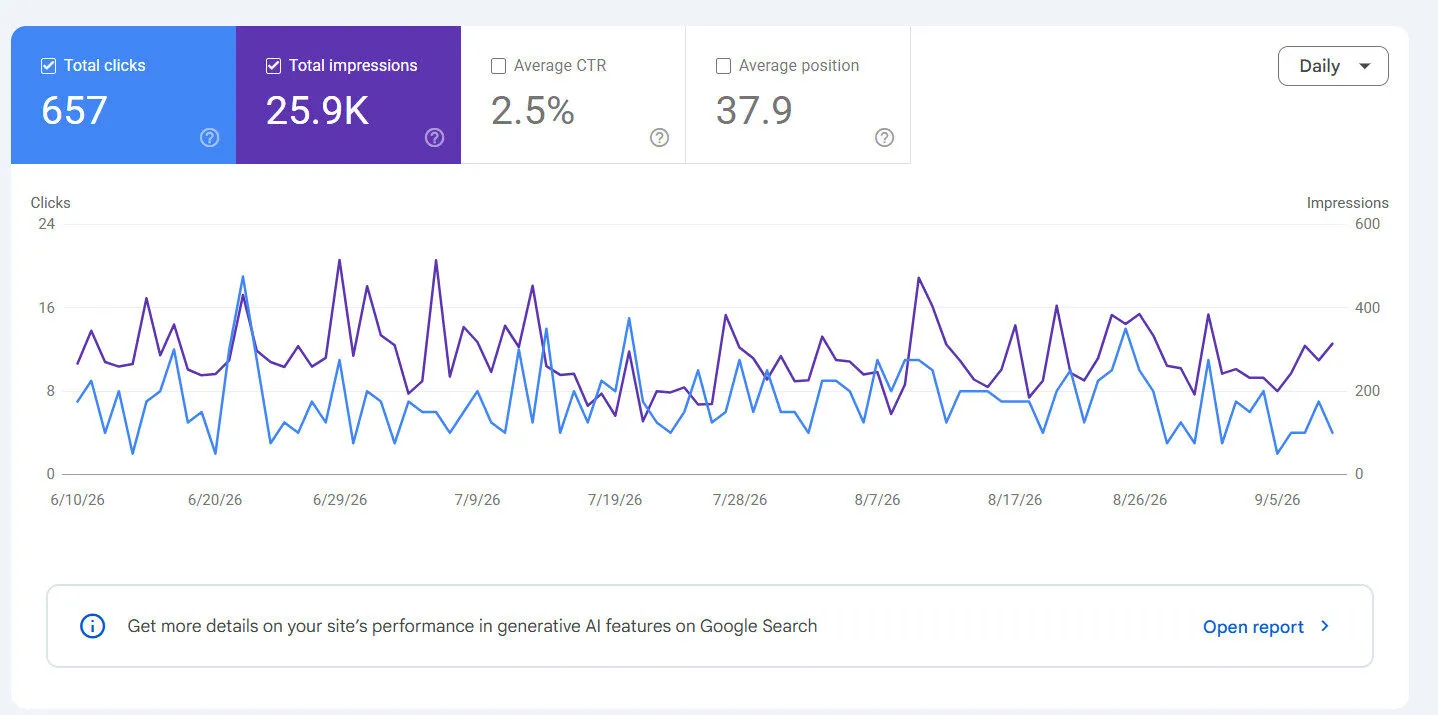
The supplied Google Search Console screenshots show the site producing measurable organic activity during the recovery period. One report shows 657 clicks, 25.9K impressions, 2.5% average CTR and 37.9 average position across the visible period from June to September 2026. A second Search Console view shows 556 impressions in its captured report.
These numbers are presented as recovery-period evidence, not as a claim that the site had already fully returned to its pre-hack potential. An average position of 37.9 itself shows that more ranking work remained. That is exactly why this case study is valuable: it documents technical SEO recovery as a process rather than pretending a hacked domain becomes perfect overnight.
When a site is compromised, the visible website may be only one part of the damage. Attackers can create thousands of spam pages, inject links, generate fake sitemaps, manipulate canonical tags or expose URLs that legitimate site owners never created.
If search engines crawl and index those pages, removing the malicious files from the server does not instantly remove every bad URL from the index. Google may continue revisiting old spam URLs. Search Console can show thousands of pages that should never exist. Crawl resources may be wasted on irrelevant paths. The site's topical identity can become distorted.
For Bhakti Yoga Shala, the supplied project note states that more than 10,000 casino pages were indexed when Aspire took over. Casino spam is particularly damaging because it has no relationship to the legitimate site's subject. A yoga and devotional-content website suddenly appearing to host gambling pages creates a severe relevance and trust mismatch.
Before search cleanup, the site has to be secure. If the vulnerability remains open, deleted spam pages can simply be regenerated.
A recovery process typically includes reviewing the CMS, plugins, themes, administrator accounts, server files and unexpected scheduled tasks or scripts. Passwords and access keys may need to be rotated. Unused components should be removed. Software needs to be updated and the hosting environment reviewed for persistence mechanisms.
This is not “SEO work” in the narrow sense, but it is essential to SEO recovery. Search engines cannot receive clean signals from a website that is still actively compromised.
With 10,000+ spam pages reported as indexed, cleanup needs pattern analysis. The team has to determine how the malicious URLs were generated. They may share folders, parameters, keywords or templates. Search Console, site crawls, server logs and indexed-search checks can help map the footprint.
The goal is to separate legitimate URLs from attack-generated URLs before implementing mass changes. A careless cleanup rule could accidentally remove valid content along with the spam.
Once patterns are understood, the site can return the correct status codes and remove malicious internal links or sitemap references. URLs that never had a legitimate replacement generally should not be redirected blindly to the homepage because that can create soft-404 signals and confuse search engines.
After the spam content is gone, Google still needs clear signals about what should remain indexed. This can involve:
The key is consistency. If a spam URL says “404” today but reappears in a sitemap tomorrow, search engines receive mixed signals. Recovery becomes faster when every technical layer agrees about which pages are valid.
Once the spam footprint is contained, the site needs to reinforce its legitimate subject. Bhakti Yoga Shala's public website focuses on Bhakti Yoga, kirtan training, retreats, streaming content, meditation and related spiritual education.
The SEO strategy should make those topics structurally clear. Core program pages need descriptive titles and headings. Event pages should use accurate dates and useful supporting content. Internal links should connect classes, training, retreats, membership and educational resources. Thin or duplicated content should be improved where necessary.
This matters because recovery is not only about deleting bad pages. Search engines also need strong positive evidence about what the site genuinely represents.
The main supplied Search Console report shows:
The graph covers a period from approximately June 10, 2026 to early September 2026. Organic clicks and impressions are present throughout the chart, showing that legitimate search visibility was active during the recovery period.
The 37.9 average position is especially important to interpret honestly. It does not indicate that the site had reached dominant rankings. It indicates that the domain still had substantial room to improve. In a recovery case, that is normal. Technical cleanup can stop damage and restore crawl/index quality, while stronger rankings take longer as search engines recrawl the domain and reassess legitimate pages.
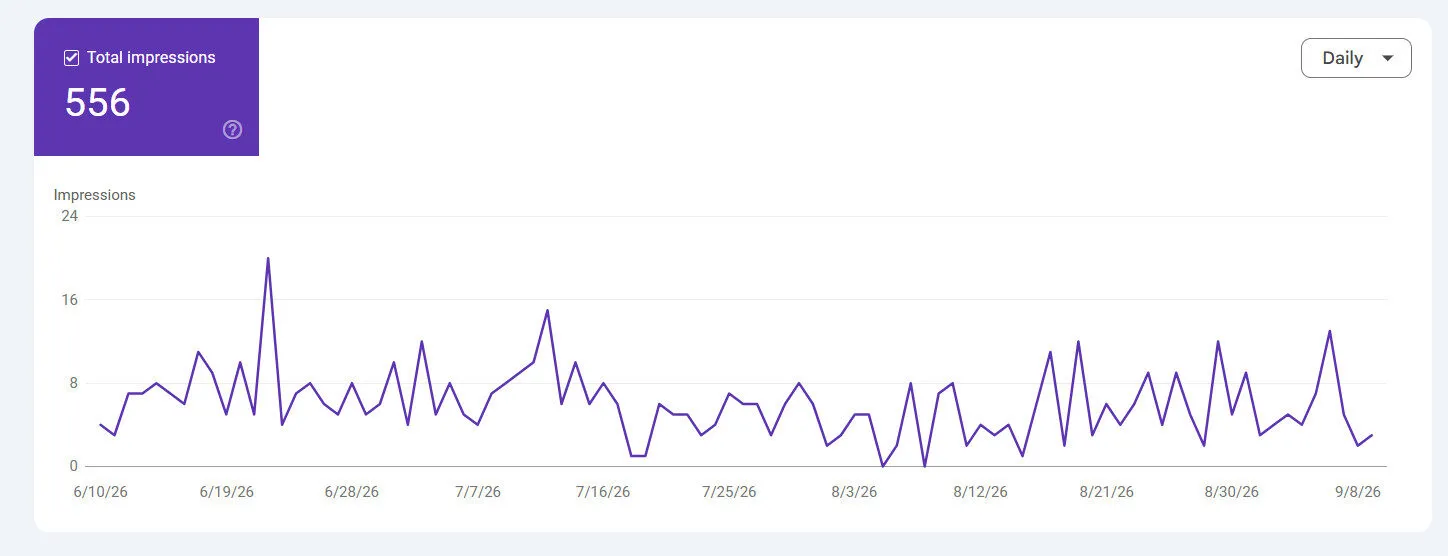
A second supplied Search Console image shows 556 total impressions across a similar June-to-September timeline. The screenshot does not show enough context to determine whether this is a filtered query, page group, search appearance or another report subset.
For that reason, this case study does not merge the 556 figure with the 25.9K total or invent a growth percentage from it. It is presented exactly as a separate captured Search Console view.
That reporting discipline matters. SEO case studies should explain what the evidence proves and avoid reverse-engineering a more dramatic story than the source data supports.
Search engines should spend their time on real pages, not endless spam URLs. Clean sitemaps, correct status codes and removal of injected links help improve crawl quality.
The objective is not to maximize the number of indexed pages. It is to make sure the right pages are indexed. A smaller clean index is healthier than a huge index filled with irrelevant hacked content.
Legitimate high-value pages should receive clear internal links from navigation, category hubs and related content. This helps restore hierarchy after malicious pages have distorted the site structure.
Updated, useful and topic-relevant content helps reinforce the site's real purpose. Author, organization and contact information should be clear where relevant.
A hacked domain requires closer monitoring even after cleanup. Sudden indexed-page spikes, strange query impressions, new unknown folders or unusual crawl patterns can indicate that malicious content has returned.
One common mistake after a hack is redirecting every deleted spam URL to the homepage. With thousands of malicious URLs, that creates a large number of irrelevant redirects and can make it harder for search engines to understand that the spam pages are genuinely gone.
If there is no legitimate replacement, a 404 or 410 is often more appropriate. Redirects should be reserved for pages where a real equivalent exists.
The same principle applies to disavow files and other aggressive interventions: they should be based on evidence, not used automatically because the site was hacked.
Clicks and impressions are useful, but hacked-site recovery needs a broader technical dashboard. Important signals include indexed-page counts, excluded URLs, crawl stats, sitemap processing, manual actions, security issues, strange query patterns and server response behaviour.
The team should also watch whether legitimate pages regain impressions for their intended topics. If casino terms decline while yoga, kirtan, training and retreat queries increase, the domain is moving back toward the correct topical footprint.
This is one reason recovery should not be judged after a few days. Search engines need time to recrawl thousands of bad URLs and reassess the clean site.
The project note states that the site had been hacked and more than 10,000 casino spam pages were indexed. The supplied Search Console evidence shows organic activity during the recovery period, including 657 clicks and 25.9K impressions in the main report. No “before versus after” click percentage is claimed because a verified pre-cleanup baseline was not supplied in the screenshots. No permanent ranking claim is made. The page documents recovery evidence and the technical strategy required to restore search quality.
A hacked website can look “fixed” to a human while remaining damaged in search for months. The malware may be gone, but Google can still know about thousands of injected URLs. That is why SEO recovery has to continue after the security incident is closed.
Bhakti Yoga Shala's case illustrates the right order of operations: contain the compromise, map the spam footprint, clean the index signals, reinforce the legitimate site structure and then rebuild rankings. Publishing more content before fixing the technical contamination would have treated the symptom rather than the cause.
This approach applies to many WordPress and CMS sites affected by Japanese keyword spam, casino spam, pharmaceutical spam or hacked doorway pages. The exact remediation depends on the attack pattern, but the principle is the same: security and SEO recovery have to work together.
The supplied project note says the website had been hacked and more than 10,000 casino-related spam pages were indexed by the time Aspire took over.
The main report shows 657 clicks, 25.9K impressions, 2.5% average CTR and 37.9 average position during the captured period. A separate report shows 556 impressions, but its filter context is not visible.
No. It shows that ranking improvement was still needed. The case study presents the work as an active SEO recovery process rather than claiming instant full restoration.
Usually not. If a malicious URL has no legitimate replacement, a correct 404 or 410 can be a cleaner signal. Redirects should be used where a real equivalent page exists.
It varies with the size of the spam footprint, crawl frequency, severity of the compromise and quality of remediation. Search engines may need weeks or months to recrawl and reassess large numbers of URLs.
No. The server may be clean while thousands of spam URLs remain known to Google. Index cleanup, sitemap correction, status-code handling, Search Console monitoring and topical rebuilding are also required.
Yes, if the original vulnerability remains or new vulnerabilities appear. Security hardening and ongoing monitoring are essential parts of long-term recovery.
Aspire Digital Solutions provides SEO, Google Ads, Meta Ads, website development, social media marketing and performance-marketing services for businesses across multiple industries.
The agency's approach is built around connecting digital visibility with commercial intent.
For SEO projects, that can include technical SEO, on-page optimisation, search-intent research, content strategy, internal linking, local SEO, authority development and ongoing performance analysis.
For paid acquisition, Aspire works across search and social channels with campaign structures designed around the services, products and locations relevant to each business.
The case studies above document the reported performance of individual campaigns.
Results from one project should not be interpreted as a guarantee that another website or advertising account will achieve the same outcome.
Competition, market demand, budget, website condition, authority, offer quality, conversion experience and campaign duration can all affect performance.
Case studies reviewed by: Aspire Digital Solutions
Services represented: SEO, Google Ads and Meta Ads
Evidence used: Supplied SEO analytics, campaign reports, Google Ads data and client-specific performance screenshots