Service Centre India operates in a high-intent local service category: home-appliance repair in Mysore. Customers usually search because an appliance has failed and they want help quickly. That creates strong demand, but it also creates intense competition across Google Ads, local results and organic search.
Aspire Digital Solutions built the acquisition system around multiple search surfaces instead of relying on one channel. Google Ads captured immediate demand. Local SEO worked to place the business inside the Maps/local-pack journey. Service and location content strengthened organic relevance. AI-search visibility work improved the clarity of the business entity and service information so the brand could also surface when users asked conversational recommendation questions.
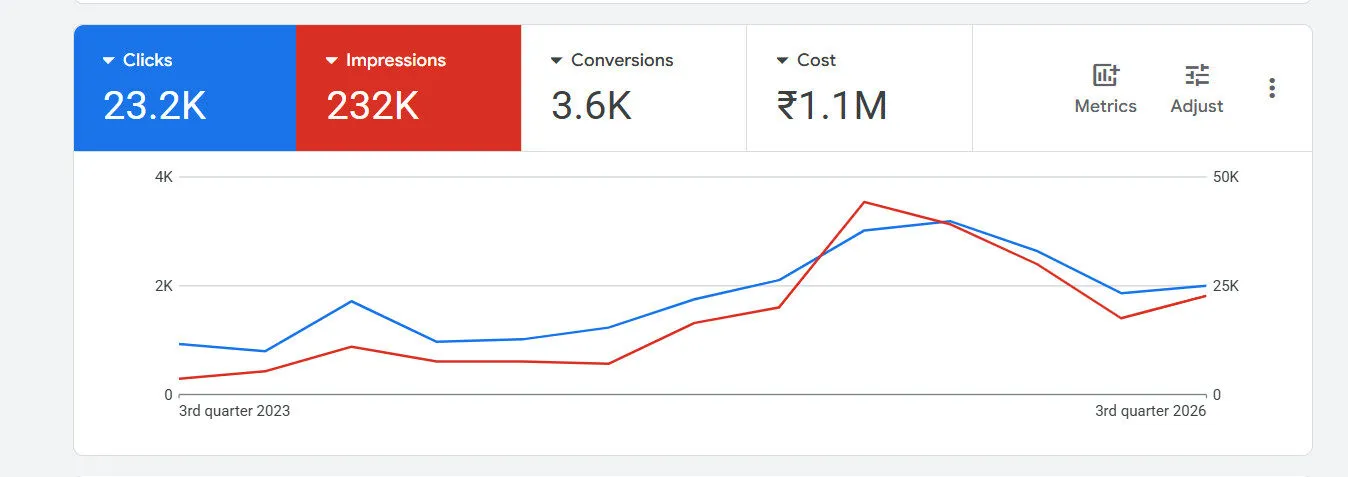
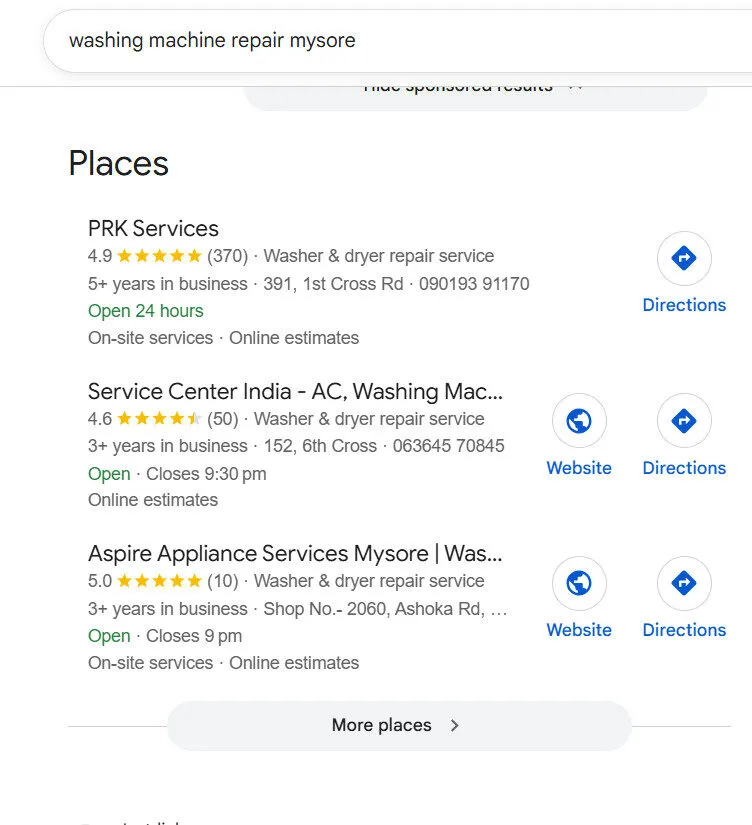
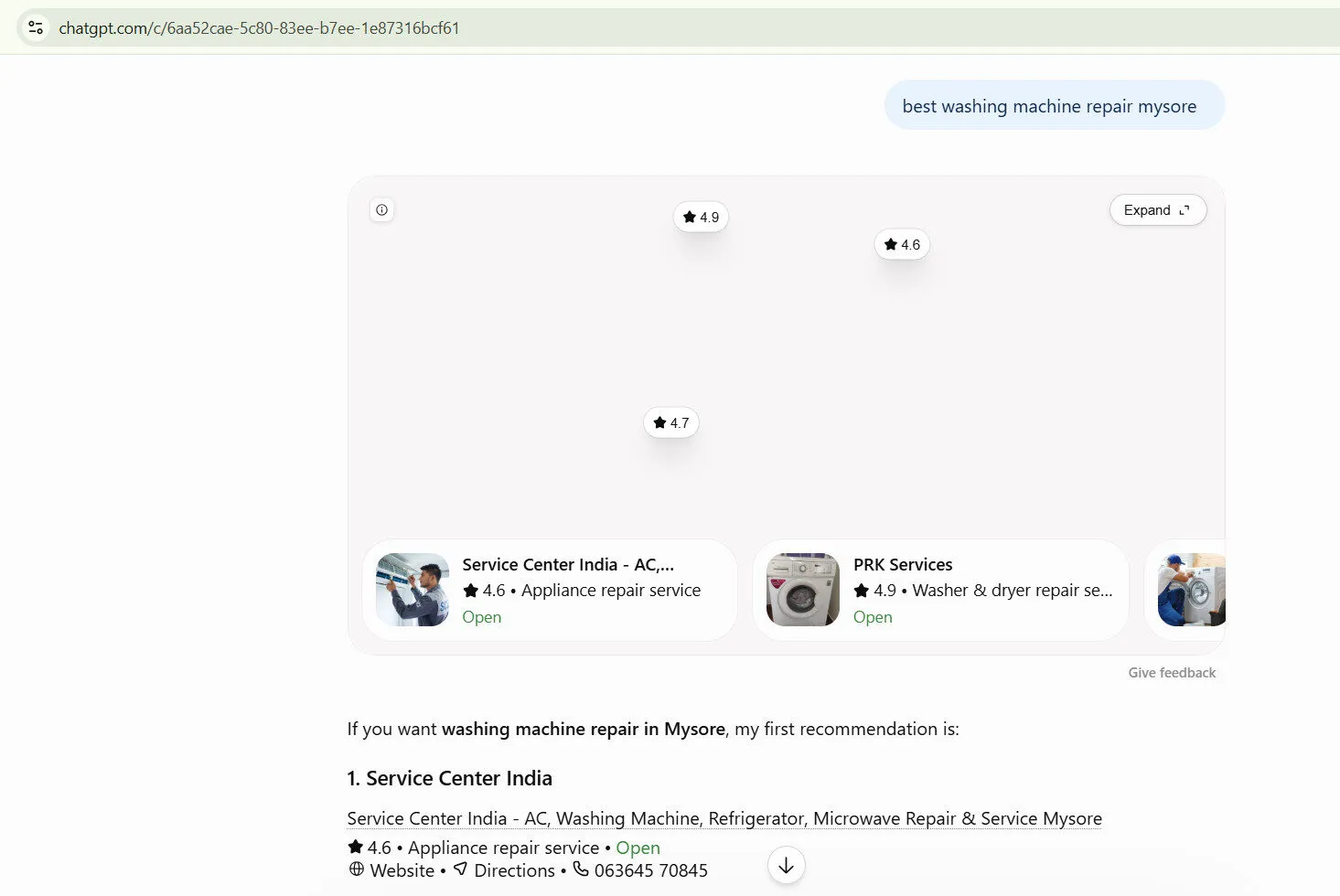
The supplied screenshots show this connected approach in practice. Google Ads recorded 23.2K clicks, 232K impressions, 3.6K conversions and ₹1.1M in spend. A Google local result for “washing machine repair mysore” shows Service Centre India in the visible local pack. A ChatGPT screenshot for “best washing machine repair mysore” lists Service Center India as the first recommendation in the captured response.
When a washing machine stops spinning or a refrigerator stops cooling, users often search immediately. That creates a valuable opportunity for local service businesses, but it also creates several SEO and advertising risks.
Searches can overlap with warranty support, manufacturer-authorized service centres, spare parts, DIY troubleshooting and job enquiries. A private multi-brand repair provider needs to reach customers whose needs match the actual service while avoiding misleading expectations about brand affiliation.
Service Centre India publicly describes itself as a private multi-brand service provider for out-of-warranty appliances. That business model makes clarity especially important in ads, landing pages and local content. The objective is not simply to rank for brand names. It is to connect relevant users with a service they can actually book.
Aspire therefore built around service intent, Mysore relevance and conversion actions.
The supplied Google Ads screenshot shows 23.2K clicks from 232K impressions. More importantly, the account recorded 3.6K conversions. That gives the traffic a performance context.
In local repair advertising, Search campaigns can be organized around appliance categories such as washing machine, refrigerator, AC, microwave, dishwasher and television repair where those services are offered. Location terms can then be combined with service intent so ad copy and landing pages remain relevant to Mysore users.
At this scale, search-term management becomes one of the most important tasks in the account. A few irrelevant query themes can consume substantial budget if they are allowed to repeat. Conversely, a strong service query can justify a dedicated campaign, ad group or location page.
The supplied report shows ₹1.1M in cost. The case study does not calculate revenue or ROAS from this figure because no verified sales or job-value data was supplied. What the evidence does support is a long-running paid-search system with substantial traffic, conversion volume and enough data to optimize by query and service category.
The right way to interpret the account is therefore operational: spend was connected to tracked conversion actions, and those actions could be used to guide budget decisions.
A user searching “washing machine repair Mysore” is expressing much stronger service intent than someone searching a generic appliance question. The closer the keyword is to a bookable service, the easier it is to write relevant ad copy and send the user to an appropriate page.
Search campaigns can also reflect common problem language: not draining, not spinning, not cooling, error code, installation, servicing and similar terms. However, every keyword expansion needs query monitoring so informational and unrelated searches do not dilute performance.
Negative keyword management is therefore part of the campaign architecture, not an optional cleanup task.
The supplied Google screenshot shows a search for “washing machine repair mysore.” In the visible local pack, Service Centre India appears alongside other local providers. This is valuable because the local pack is often where users compare nearby services, ratings, opening information, websites and directions before making contact.
Local SEO depends on a consistent set of signals. The Google Business Profile needs accurate business information. The website should clearly describe the services and the areas served. Reviews and local relevance help reinforce trust. Landing pages should avoid thin city-name swapping and instead provide useful service information for the location.
For an appliance-repair business, location pages can cover practical information such as the appliances serviced, service model, contact method, visiting charges where applicable, operating hours and the difference between private out-of-warranty service and authorized manufacturer support.
A second supplied screenshot shows a ChatGPT query for “best washing machine repair mysore.” In the captured response, Service Center India is listed as the first recommendation.
This is evidence of point-in-time AI-search visibility. It is not a permanent ranking and should not be marketed as one. Generative answers can change based on the model, session, location, sources available to the system and the exact wording of the query.
The strategic importance is that users increasingly ask recommendation questions conversationally instead of typing traditional keywords only. Brands that have clear, consistent and crawlable service information are easier for search and AI systems to understand.
For Service Centre India, that means the same fundamentals matter across both SEO and LLM-oriented search visibility: clear business identity, Mysore relevance, explicit service categories, transparent private-service positioning, consistent contact information and useful pages that answer common repair questions.
Appliance-repair websites often create many pages by combining every brand, appliance and neighborhood. That can generate a large footprint, but scale alone does not make the pages useful. Search engines increasingly reward pages that provide distinct value and make the business relationship clear.
A stronger page can explain what type of repair is offered, which appliance problems are commonly handled, whether the service is for out-of-warranty products, how the booking process works and where service is available. FAQ sections can answer the questions customers actually ask before calling.
Location pages can then use truly local information rather than changing only the place name. This improves user experience and reduces the risk of a site feeling templated or misleading.
Independent appliance repair is a category where users may assume official brand authorization based on a search result. That makes transparency important both ethically and strategically.
The website should clearly state when it is a private multi-brand service provider and when it handles out-of-warranty products only. Ads and pages should avoid language that could falsely imply manufacturer ownership or authorization.
Clear positioning helps qualify users before they call and supports long-term trust. It also gives search systems a more accurate understanding of what the business is.
All figures and visibility examples above are based on the supplied screenshots. The page does not claim revenue, ROAS, completed repair jobs or permanent AI rankings. Google local results and AI recommendations can vary by location, personalization, date and query wording.
A local service business should not be dependent on a single search surface. Google Ads can capture demand immediately but requires ongoing spend. The local pack can create visibility when users compare nearby providers. Organic service pages can attract long-tail searches over time. AI assistants create another discovery layer for recommendation-style queries.
When these channels are built around the same accurate business information, each one reinforces the others. Search-term data can inspire SEO content. Local profile questions can become FAQ sections. Useful service pages can support both organic discovery and AI retrieval. Stronger entity clarity can reduce ambiguity across the web.
The result is not “SEO plus ads” as two unrelated deliverables. It is one demand-capture system with multiple entry points.
Aspire worked across Google Ads, local SEO, service/location content and AI-search visibility so the business could capture demand across paid search, Maps/local results and conversational recommendation queries.
The supplied report shows 23.2K clicks, 232K impressions, 3.6K conversions and ₹1.1M in cost.
A supplied Google screenshot for “washing machine repair mysore” shows Service Centre India in the visible local pack.
A supplied ChatGPT screenshot for “best washing machine repair mysore” lists Service Center India first in the captured recommendation response.
No. AI-generated recommendations are dynamic and can change. The screenshot is useful as evidence that the brand was retrievable and recommended in that captured session, not as a permanent ranking guarantee.
No. The 3.6K figure is the conversion count shown in Google Ads. Without CRM-confirmed jobs, the case study does not convert that platform number into a customer count.
Local SEO provides another high-intent discovery path and can continue generating visibility without paying for every click. It also strengthens the brand's presence when users compare providers before contacting one.
Aspire Digital Solutions provides SEO, Google Ads, Meta Ads, website development, social media marketing and performance-marketing services for businesses across multiple industries.
The agency's approach is built around connecting digital visibility with commercial intent.
For SEO projects, that can include technical SEO, on-page optimisation, search-intent research, content strategy, internal linking, local SEO, authority development and ongoing performance analysis.
For paid acquisition, Aspire works across search and social channels with campaign structures designed around the services, products and locations relevant to each business.
The case studies above document the reported performance of individual campaigns.
Results from one project should not be interpreted as a guarantee that another website or advertising account will achieve the same outcome.
Competition, market demand, budget, website condition, authority, offer quality, conversion experience and campaign duration can all affect performance.
Case studies reviewed by: Aspire Digital Solutions
Services represented: SEO, Google Ads and Meta Ads
Evidence used: Supplied SEO analytics, campaign reports, Google Ads data and client-specific performance screenshots