...
...
We help businesses scale with data-driven strategies and world-class design.
Get Started rocket_launchShare your details, and our experts will map out a custom strategy.
We've successfully logged your details. Our CRM team will reach out to you shortly.
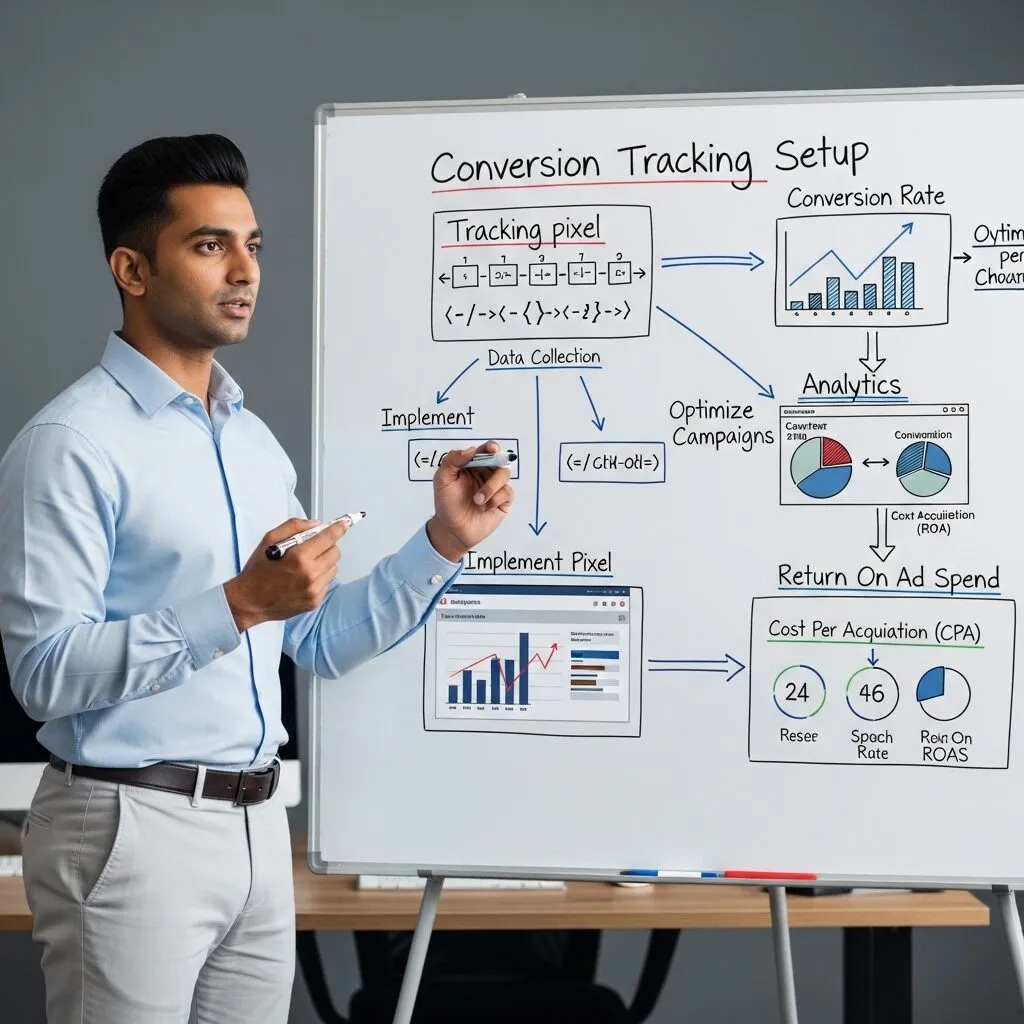
Conversion tracking measures which marketing actions lead to valuable business outcomes, such as purchases, leads, or sign-ups.
By linking clicks and user interactions to measurable results, it enables data-driven decision-making and campaign optimization across digital channels and devices.
It provides accurate ROI analysis by identifying the specific interactions that result in conversions, ensuring marketing spend is allocated efficiently.
Tracking irrelevant actions produces misleading data that skews campaign optimization.
Loss of critical conversion records prevents accurate reporting and data-driven scaling.
Misidentifies effective marketing channels, misguiding budget allocation and ROI analysis.
Misrepresents campaign performance over time by failing to capture the true customer journey.
Reduces cross-device and privacy-limited measurement accuracy in a privacy-first world.
Skews ROI calculations and compromises bidding strategies by providing incorrect financial signals.
Undetected technical failures create inconsistent data and reporting gaps that hinder growth.
Conversion tracking is the systematic measurement of user actions that reflect business objectives. It typically involves: digital tags placed on websites, apps, or landing pages; event-based triggers capturing purchases, form submissions, or other conversions; and data aggregation into advertising or analytics platforms for reporting.
Key Metrics Include:
Conversions, Conversion rate (%), Cost per acquisition (CPA), and Value per conversion.
Understanding search behavior is the foundation of aligning your bidding strategy with high-value actions.
A systematic framework for ensuring data integrity and measurement accuracy.
Verify all tags or GTM triggers are active and firing correctly across the site architecture.
Ensure models (last-click, data-driven) align with your specific campaign goals and sales cycle.
Match sales cycle realities (e.g., 30, 60, or 90 days) for accurate campaign measurement.
Use tag assistant tools across devices and browsers to confirm technical functionality.
Compare analytics (GA4) with ad platforms to detect gaps and potential tracking leaks.
Ensure static or dynamic values reflect true business objectives and ROAS targets.
Validate enhanced conversions or hashed first-party data implementation to ensure measurement accuracy in a privacy-first world.
Technical gaps and environmental constraints often undermine tracking accuracy:

Mapping user psychology to performance benchmarks for ROI optimization.
Users seek knowledge; immediate conversion unlikely
Users compare options; partial lead generation possible
Direct purchase intent; primary ROI target for e-commerce
Users search specific brands; minimal direct impact
Mechanisms, privacy compliance, and cross-device benefits for modern attribution.
Reducing browser limitations and preventing data loss through cloud-based collection.
CRM integration and effective GCLID usage to bridge the gap between clicks and sales.
Leveraging conversion data for highly automated and efficient bid strategies.
Comparing last-click, first-click, linear, and advanced data-driven approaches.
Static vs dynamic allocation and the resulting impact on long-term ROI.
Navigating challenges in mobile, desktop, and multi-platform user journeys.
Differentiating metrics, benchmarks, and specific analytical strategies for each model.
The effects of informational, transactional, and commercial intent on conversion rates.
Stepwise technical guides designed specifically for SMEs to detect tracking gaps.
Ensuring compliance through consent mode and first-party data considerations.
Linking conversions to business performance and systematic budget allocation.
Navigate the complexities of measurement and attribution with these data-backed expert answers:
Data-driven attribution distributes credit across all touchpoints for more accurate insights. Last-click may be simpler for short sales cycles or low-volume campaigns.
Conduct monthly audits for technical accuracy, with additional reviews after site updates, platform changes, or new campaigns.
Yes, using click IDs (e.g., GCLIDs) imported from CRM systems. Accuracy depends on data matching and proper integration.
Differences arise from event mapping, attribution windows, and reporting intervals across analytics and ad platforms.
They improve cross-device and privacy-restricted measurement accuracy but require compliant first-party data collection.
Conversion tracking connects marketing actions to measurable business outcomes. Systematic implementation, regular audits, and strategic attribution enable accurate insights, support automated bidding, and optimize campaigns. Awareness of limitations, user intent, and platform nuances ensures reliable decision-making across digital marketing channels.