
...
...
...
...
How to Structure a Search Campaign: Analytical Guide for Businesses in Mysore & Bangalore
We help businesses scale with data-driven strategies and world-class design.
Get Started rocket_launchLet's Elevate Your Brand
Share your details, and our experts will map out a custom strategy.
Request Received!
We've successfully logged your details. Our CRM team will reach out to you shortly.
Search Campaign Structure
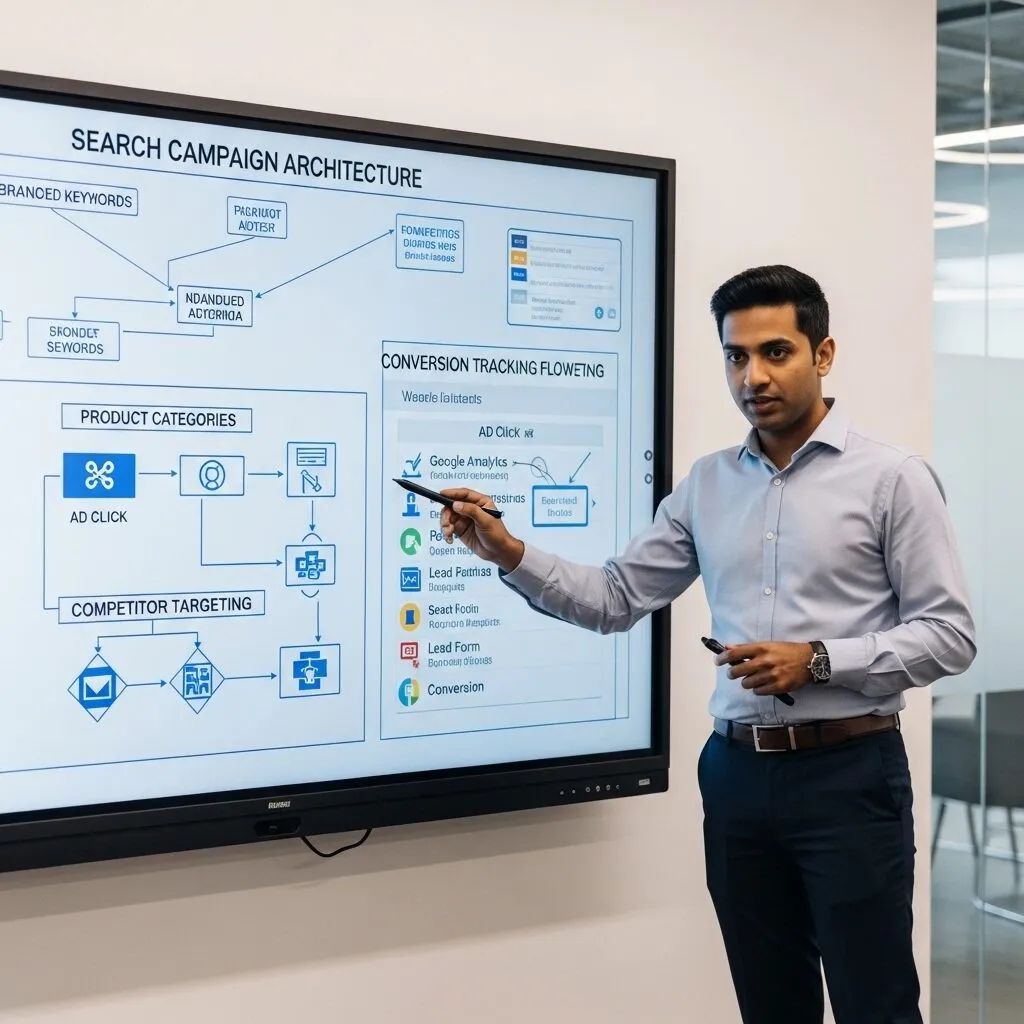
A search campaign is structured by aligning account hierarchy, campaigns, ad groups, keywords, and landing pages to business objectives. Proper organization ensures that every click contributes to a predefined commercial goal.
Logical Organization
Aligning ad groups with tightly themed keywords ensures high relevance. Proper organization reduces wasted spend and improves ad performance across the entire account hierarchy.
Local Market Precision
In competitive local markets like Mysore and Bangalore, granular targeting increases conversion quality by matching ad copy precisely to regional search behavior. See our Google Ads services in Bangalore and Google Ads services in Mysore for city-specific detail.
The Structural Verdict
Top 7 Reasons Search Campaigns Fail
Poor campaign hierarchy
Prevents algorithmic optimization and machine learning, leading to inflated cost-per-click and inefficient spend.
Mismatched keywords and ad copy
Significantly lowers click-through rates (CTR) and reduces total conversions due to a lack of search relevance.
Ignoring negative keywords
Triggers irrelevant searches and "junk traffic," wasting daily budget on users who have no intention of converting.
Excessive campaign fragmentation
Dilutes account data signals, which slows down Smart Bidding learning phases and destabilizes ROI.
Unclear business goals
Prevents the algorithm from targeting the right high-value audience effectively, resulting in poor lead quality.
Inadequate tracking setup
Limits measurable ROI and prevents informed optimization decisions due to "blind" bidding without conversion feedback.
Premature optimization changes
Disrupts algorithmic learning cycles by changing variables too quickly, resulting in reduced campaign performance.
Defining Search Campaigns
A search campaign is a hierarchical system that organizes advertising assets around specific business objectives and audience intent.
- Account & Campaigns: The central hub for tracking, aligned with primary goals like lead generation, sales, or awareness.
- Ad Groups: Structural units containing tightly themed keywords and ad variations to ensure message-to-market match.
- Ads & Keywords: The visible content triggered by user queries, serving as the final touchpoint in the hierarchical flow.
Structural Mechanism:
Clear hierarchical alignment ensures Google’s AI can effectively optimize for relevance and bidding efficiency.

Diagnosing Campaign Inefficiencies
Follow this systematic protocol to restore algorithmic performance and maximize ROI.
- 01Account & Intent Audit Check campaigns, ad groups, and keywords for strict alignment with landing pages. Analyze search term reports to identify irrelevant triggers.
- 02Relevance & Conversion Review Compare headlines and descriptions against user intent. Ensure conversion tracking is active for calls, leads, and purchases.
- 03Bidding & Budget Assessment Evaluate if Smart Bidding or CPA targets align with current budget and volume. Monitor for patterns of high cost or low CTR.
- 04Controlled Iteration Apply incremental optimizations in controlled cycles without disrupting algorithmic learning phases.
Step-by-Step Campaign
Structuring Framework
Objective & Segmentation
- Define primary business goals (Leads, sales, inquiries)
- Segment campaigns by objective (One goal per campaign)
- Set up conversion tracking using GA4 or platform metrics
Granular Ad Development
- Tightly focused ad groups (5–15 keywords grouped by intent)
- Craft responsive ads (8–10 headlines, 2–4 descriptions)
- Implement negative keywords to block irrelevant traffic
Landing Page & Iterative Scaling
- Match landing pages to specific ad promises
- Ensure content relevance and optimized conversion flow
- Monitor, test, and optimize iteratively in controlled intervals
Common Mistakes and
Why Fixes Fail
Structural misalignments often neutralize even the most aggressive optimization efforts:
- Implementation failures: Misaligned landing pages, overly broad keywords, or insufficient budgets disrupt the conversion chain.
- Edge cases: Seasonal spikes and hyper-local search variations reduce the predictability of standard bidding models.
- Limitations: Algorithmic learning requires a data threshold; underperforming campaigns often mislead machine learning optimization.
Stage-Specific
Considerations
- Awareness Stage: Overly generic ads may generate impressions but typically yield low engagement and wasted spend.
- Consideration Stage: Excessive reliance on broad match keywords fails to capture specific, qualified purchase intent.
- Decision Stage: Poor landing page design or ambiguous CTAs drastically reduce final conversion rates.

Campaign Structuring
Framework
A systematic roadmap to align account hierarchy with measurable business growth.
Identify leads, sales, or inquiries to anchor the entire campaign structure.
Assign one goal per campaign to prevent algorithmic data confusion and overlap.
Maintain 5–15 keywords each, grouped strictly by user search intent.
Match landing pages to specific ad promises for maximum relevance and Quality Score.
Prevent irrelevant traffic and ensure conversion tracking provides valid learning signals.
Adjust keywords, bids, and ads in controlled weekly intervals based on ROI trends.
Successful search campaign structuring requires precise alignment between intent and execution. Continuous testing ensure that your account scales with market demand while maintaining maximum cost-efficiency.
Cluster Expansion Subtopics
Keyword & Smart Bidding
Advanced techniques for local market research and specific Smart Bidding optimization strategies.
Landing Pages & Negative Lists
Design frameworks for conversion rate improvement and systemic negative keyword list management.
Seasonality & Multi-Device
Adjusting campaigns for seasonal shifts and device-specific bidding considerations to protect ROI.
Reporting & A/B Testing
Deep-dive analytics reporting paired with iterative testing of ad headlines and descriptions.
Benchmarking & ROI Tracking
Local competitor benchmarking and advanced ROI tracking for multi-product campaign environments.
Hyperlocal & Automation
Hyperlocal audience segmentation and defining automation limits through strategic manual overrides.
Local Business
Performance Scenarios
IT Training Institute
Bangalore Market- Separate "Python Course" campaigns
- Separate "Data Science" campaigns
Plumbing Service
Mysore Market- Emergency repair campaigns
- Pipe installation campaigns
E-commerce Startup
Bangalore Market- Product-specific ad groups
- Revenue-item highlighting

Frequently Asked Questions
Navigate the complexities of campaign management with these data-backed expert answers:
How much budget is typically required?
Costs depend on competition and keywords; SMEs may allocate ₹20,000–₹50,000 per month for measurable engagement and lead generation.
Can small businesses manage this internally?
Yes, with trained personnel and proper tracking; otherwise, structured guidance or consultancy is beneficial to prevent wasted ad spend.
How long before meaningful results appear?
Initial impressions and clicks appear in 30 days, but consistent optimization typically takes 60–90 days to achieve conversion stability.
How are keywords chosen effectively?
Keywords are selected based on intent alignment, local relevance, competition intensity, and historical performance data.
What are common implementation pitfalls?
Mismatched landing pages, broad or irrelevant keywords, insufficient budget, and premature bid changes often reduce campaign efficiency.
Efficiency through
Structured Hierarchy.
Properly structuring a search campaign ensures alignment between business goals, audience intent, and algorithmic optimization. By applying a hierarchical framework, monitoring performance, and iterating in cycles, businesses in Mysore and Bangalore can improve efficiency, reduce wasted spend, and increase the relevance and quality of leads.