Search Campaigns vs Performance Max Campaigns: Which Should You Use?
Direct Answer
Search campaigns are usually better when you need high-intent traffic, keyword control, lead quality, and clearer budget management. Performance Max campaigns are better when you have strong conversion tracking, enough data, good creative assets, and want to reach users across Search, Shopping, YouTube, Display, Gmail, Maps, and other Google placements.
The best choice is often not Search or Performance Max. It is usually Search first, Performance Max second, then both together with clear tracking, clean budgets, and overlap controls.
This topic matters now because Google is actively pushing Performance Max inside ad accounts, often before businesses are ready for it. In Mysore and Bangalore, we at Aspire Digital Solutions frequently see businesses moving budgets into Performance Max without understanding where the spend goes or why lead quality changes.
What Is a Google Ads Search Campaign?
A Search campaign is a Google Ads campaign that shows text ads when people search for terms related to your product or service.
Search campaigns are built around keyword intent. You choose keywords, write ads, set a budget, select locations, choose bidding settings, and send users to landing pages. When someone searches for a relevant query, your ad may appear on Google Search or Search Partner placements, depending on your settings.
Simple Example
A dentist in Bangalore may use a Search campaign for keywords such as:
These searches show active demand. The person already has a problem and is looking for a solution.
What Is a Performance Max Campaign?
A Performance Max campaign is a goal-based Google Ads campaign that uses automation to serve ads across multiple Google channels from one campaign.
Instead of choosing only Search keywords, you provide goals, budget, creative assets, product feeds when relevant, audience signals, search themes, landing pages, and conversion data. Google's system then decides where and how to show ads based on the campaign objective.
Performance Max can serve across placements such as:
Simple Example
An ecommerce brand selling running shoes may use Performance Max to show:
Performance Max is not just a Search replacement. It is a cross-channel performance campaign.
Search Campaigns vs Performance Max Campaigns: Main Difference
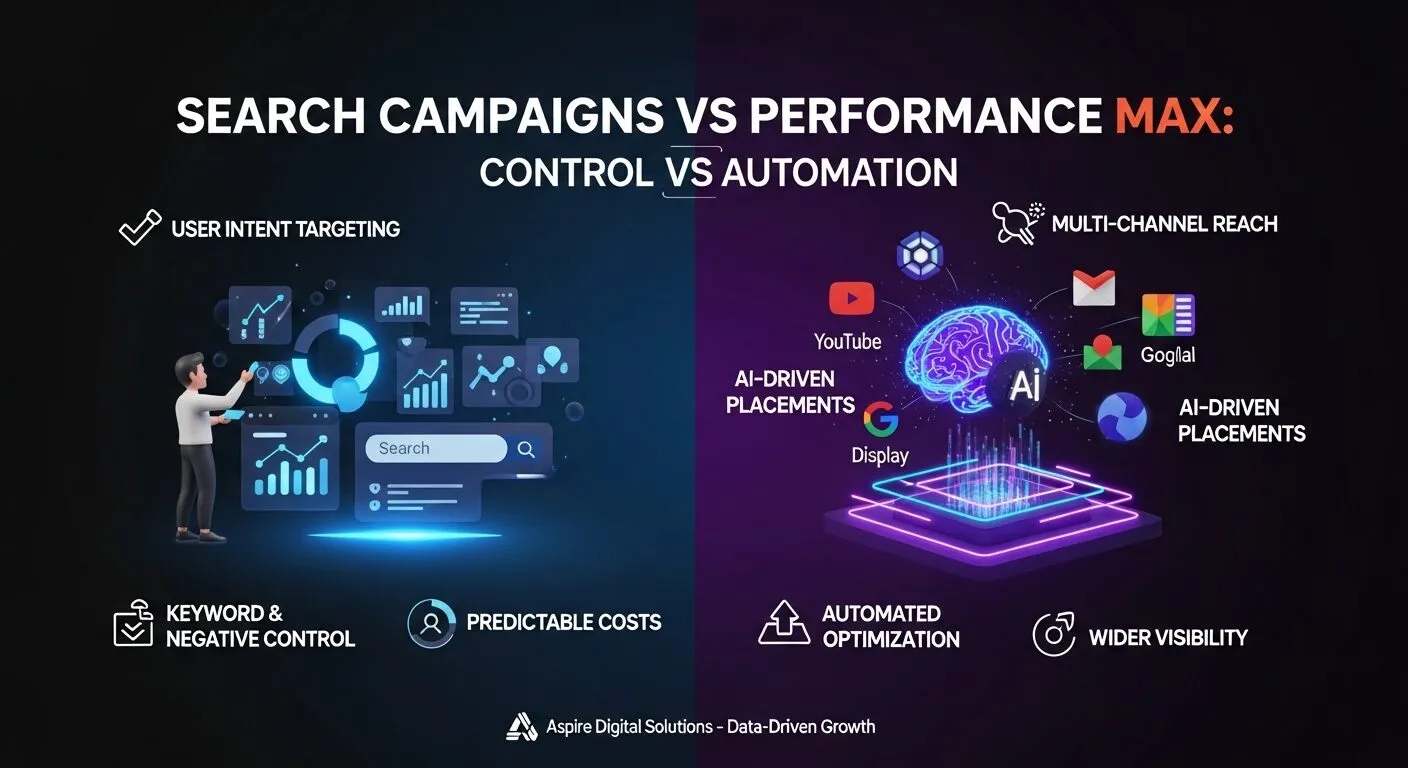
| Factor | Search Campaigns | Performance Max Campaigns |
|---|---|---|
| Main targeting input | Keywords | Goals, assets, feeds, signals, search themes |
| Main strength | High-intent search traffic | Cross-channel conversion growth |
| Control level | Higher | Lower |
| Placement coverage | Mostly Search | Search, Shopping, YouTube, Display, Gmail, Maps, and more |
| Creative needs | Text ads and extensions | Text, images, video, feeds, audience signals |
| Best for | Lead generation, local services, precise intent | Ecommerce, scaling, remarketing, cross-channel reach |
| Risk | Limited scale if search volume is low | Poor lead quality if tracking is weak |
| Budget fit | Better for smaller budgets | Better with enough data and conversion volume |
| Reporting clarity | Usually clearer | Improved, but still more automated |
| Learning dependency | Moderate | High |
How Search Campaigns Work
Search campaigns follow a simple cause → process → outcome model.
Cause
A user searches for a product, service, brand, problem, or location.
Process
Google compares the search query with your keywords, match types, ad relevance, landing page, bid strategy, expected performance, and auction competition.
Outcome
If your ad is eligible and competitive, it can appear on the search results page.
This makes Search useful when demand already exists. You are not creating the demand. You are capturing it.
How Performance Max Campaigns Work
Performance Max also follows a cause → process → outcome model, but the process is broader.
Cause
You give Google a conversion goal, budget, creative assets, audience signals, landing pages, search themes, and conversion data.
Process
Google predicts which users, channels, formats, and placements are likely to help achieve the goal.
Outcome
Ads can serve across multiple Google placements, and budget shifts automatically toward predicted conversion opportunities.
This makes Performance Max useful when you want to scale beyond keyword demand or use Shopping, video, display, and remarketing in one automated system.
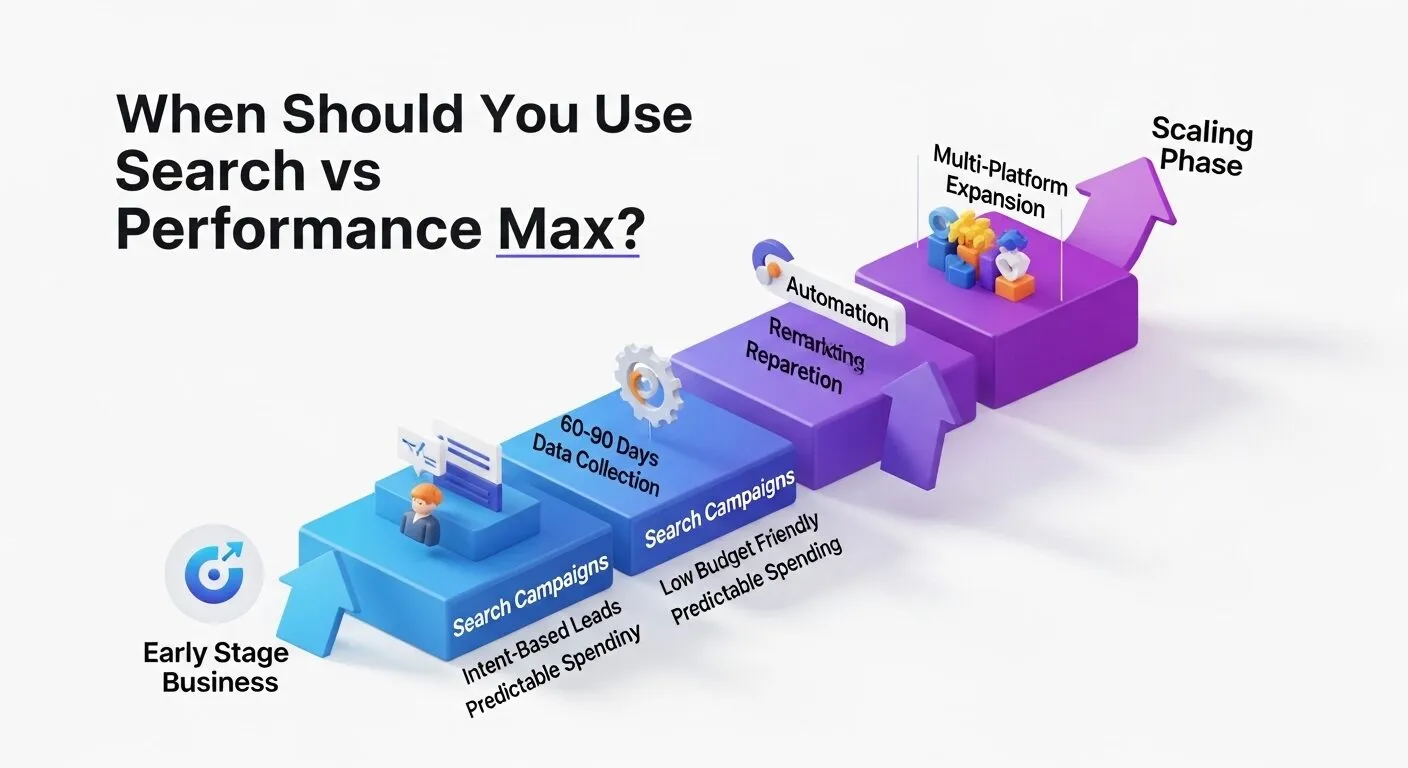
Which Campaign Should You Start With?
Start with Search campaigns if you have limited budget, weak tracking, high lead-quality concerns, or clear high-intent keywords.
Start with Performance Max if you already have reliable conversion tracking, enough conversion volume, strong creative assets, product feeds when needed, and a clear goal such as purchase value, qualified leads, or store visits.
Use both if Search is already capturing core intent and you need incremental conversions from broader placements.
Search First: Best Situations for Search Campaigns
Search campaigns are usually the safer starting point when control matters more than scale.
Choose Search When:
Small budgets are usually better spent on high-intent searches first.
Local services, B2B, legal, healthcare, finance, and high-ticket services often need tighter control.
If "emergency plumber near me" is your money term, Search lets you focus on that intent.
Search can run with text ads and landing pages. PMax needs stronger creative inputs.
If you only track form fills, PMax may optimize toward users who submit forms but do not become customers.
Search makes it easier to see which queries, ad groups, and landing pages drive results.
Performance Max First: Best Situations for PMax
Performance Max can work well when the account is ready for automation.
Choose Performance Max When:
PMax can work well for Shopping-led ecommerce when product data is clean.
Purchases, revenue, qualified leads, offline sales, or CRM-based conversion imports help the system learn.
Automation performs better when it has enough signals to learn from.
PMax needs creative quality because it can serve outside Search.
If Search campaigns are limited by available demand, PMax can find additional conversions across other placements.
PMax should not be allowed to absorb branded demand or high-performing Search terms without review.
Decision Matrix: Search vs Performance Max
| Business Situation | Better Starting Point | Reason |
|---|---|---|
| Local plumber with ₹30,000 monthly budget | Search | High-intent local queries matter most |
| Ecommerce store with product feed and purchase tracking | Performance Max + Search | PMax can scale Shopping, Search can protect key terms |
| B2B SaaS with long sales cycle | Search first | Lead qualification and CRM tracking are critical |
| New business with no conversion data | Search | Easier to control early learning |
| Brand with strong video and creative assets | PMax | Better use of cross-channel formats |
| Law firm or clinic | Search | Lead quality and compliance matter |
| Retail brand with 100+ SKUs | PMax | Product feed and conversion value data help automation |
| Business with poor landing pages | Neither yet | Fix conversion path first |
| Business with call tracking and CRM imports | Search + PMax | Better data supports both |
Readiness Score: Should You Use Performance Max?
Score each item from 0 to 2.
| Criteria | 0 Points | 1 Point | 2 Points |
|---|---|---|---|
| Conversion tracking | Only clicks or basic forms | Forms and calls | Qualified leads, sales, revenue, CRM imports |
| Monthly conversion volume | Very low | Moderate | Strong and consistent |
| Creative assets | Text only | Some images | Strong image and video assets |
| Landing pages | Generic | Service/product pages | High-converting pages by intent |
| Budget | Very limited | Moderate | Enough to support testing |
| Product feed | Not applicable or weak | Basic feed | Clean feed with useful titles, images, prices |
| Brand control | No exclusions | Some controls | Brand exclusions and negative keyword plan |
| Reporting process | No review | Monthly review | Weekly search term and asset review |
Score Meaning
| Score | Recommendation |
|---|---|
| 0–6 | Use Search first. Fix tracking and landing pages before PMax. |
| 7–11 | Test PMax carefully with limited budget and strict monitoring. |
| 12–16 | Use Search and PMax together with clear roles. |
How Search and Performance Max Interact
Search and Performance Max can both be eligible for some search queries. This is where many advertisers get confused.
A clean account structure should decide which campaign protects core demand and which campaign finds additional conversions.
Practical Rule
Use Search campaigns to protect high-value, high-intent, and branded keywords. Use Performance Max to expand beyond those keywords, support ecommerce feed coverage, and find conversions across other Google placements.
Example
A home renovation company may structure campaigns like this:
| Campaign | Role |
|---|---|
| Brand Search | Protect branded searches |
| Non-brand Search | Capture high-intent service terms |
| Competitor Search | Test competitor demand separately |
| Performance Max | Reach users across Shopping, YouTube, Display, Maps, Search, and remarketing |
| Remarketing or Demand Gen | Support mid-funnel education if needed |
This structure prevents Performance Max from becoming a mixed bucket where brand, non-brand, remarketing, and prospecting data are hard to separate.
Does Performance Max Steal Traffic From Search?
Performance Max can overlap with Search campaigns, especially when Search campaigns are limited by budget, targeting, Ad Rank, match type, or missing exact-match coverage.
This does not always mean PMax is harmful. Sometimes it captures extra conversions. The problem starts when PMax absorbs easy branded demand, low-quality leads, or terms that should be controlled inside Search.
Signs of PMax Cannibalization
How to Reduce Cannibalization
Performance Max for Lead Generation
Performance Max can work for lead generation, but only when lead quality data is strong.
The common mistake is tracking every form fill as a valuable conversion. If Google only sees form submissions, it may optimize toward users who submit forms easily. That can include low-intent users, unqualified prospects, spam, or bots.
Better Lead Generation Tracking
| Weak Tracking | Better Tracking |
|---|---|
| Form submit | Qualified lead |
| Phone click | Connected call over a minimum duration |
| Chat start | Sales-qualified chat |
| Download | Demo booked |
| Lead captured | Closed deal or pipeline value |
For lead generation, Search is usually safer at the beginning. PMax becomes more useful when offline conversion tracking or CRM imports are in place.
Performance Max for Ecommerce
Performance Max is often stronger for ecommerce than for basic lead generation because ecommerce accounts can send clearer conversion value signals.
A product purchase gives Google more useful data than a simple lead form. Product feeds also give PMax structured information such as product title, price, category, image, availability, and landing page.
Ecommerce PMax Works Better When:
Performance Max for Local Businesses
Local service businesses should be careful with Performance Max.
A local business usually depends on urgent, high-intent searches. For example:
These searches are usually better controlled with Search campaigns first.
Performance Max may still help local businesses when they have:
For most local advertisers, the safer sequence is:
Businesses investing in Google Ads Services in Mysore should evaluate Search versus PMax carefully based on their local search intent and lead quality needs.
Budget Split Framework
| Situation | Search Budget | PMax Budget | Reason |
|---|---|---|---|
| New lead-gen account | 90% | 10% test or none | Protect high-intent spend first |
| Small local business | 80–100% | 0–20% | Search usually carries intent |
| Ecommerce with clean feed | 30–50% | 50–70% | PMax can scale product visibility |
| Mature account with CRM imports | 50–70% | 30–50% | Both can use stronger signals |
| Brand with strong creative | 40–60% | 40–60% | PMax can use video and display reach |
| Poor tracking | 100% | 0% | Fix tracking before automation |
The right split should be based on marginal performance. If adding PMax increases total qualified conversions without hurting Search efficiency, keep scaling it. If PMax only moves existing conversions from Search into an automated campaign, reduce it.
For businesses also investing in SEO Services in Bangalore, combining organic visibility with paid search creates a stronger foundation for PMax to build on.
Step-by-Step Framework to Use Both Campaigns Together
1 Define the Campaign Role
Before launch, assign each campaign a job.
Do not let every campaign chase the same goal with no separation.
2 Fix Conversion Tracking
Track meaningful actions, not vanity actions.
For ecommerce, track purchases and revenue.
For lead generation, track qualified leads, calls, booked appointments, pipeline, or closed sales.
Bad data creates bad automation.
3 Protect Core Search Terms
Create Search campaigns for your most valuable keywords. Use exact match where priority matters. Keep ad groups tight enough that ad copy and landing pages match the query intent.
4 Build PMax With Strong Inputs
Performance Max needs useful inputs:
5 Review Overlap
Check whether PMax is serving for terms that should belong to Search:
6 Judge by Total Account Results
Do not judge PMax only by campaign CPA. Ask:
Common Mistakes With Search Campaigns
Broad match can work, but it needs strong conversion data and active search term review. Without that, it can spend on weak intent.
Different search intents need different pages. "Cost," "near me," "best," "emergency," and "service provider" queries should not always land on the same page.
Search campaigns still need negative keyword management. Otherwise, irrelevant traffic can drain spend.
A cheap lead is not always a good lead. Track lead quality and revenue, not only form fills.
Common Mistakes With Performance Max
PMax depends heavily on conversion signals. Weak tracking causes weak optimization.
PMax can serve beyond Search, so weak images and videos can damage performance.
If PMax takes credit for users who were already searching for your brand, campaign-level CPA may look better than true incremental value.
Do not ask one PMax campaign to drive purchases, newsletter signups, low-value downloads, and lead forms at the same time.
For lead generation, review qualified lead rate, sales rate, and revenue per lead.
Edge Cases
A PMax Shows Better CPA Than Search
Check whether PMax is getting branded demand, remarketing users, or lower-quality leads. A lower CPA does not always mean better business impact.
B Search Has Low Volume
If Search volume is small, PMax may help reach new users. But fix tracking before expanding.
C Ecommerce PMax Works, Search Looks Weak
Keep Search for brand, competitor, category, and high-margin product terms. PMax can scale feed-based sales, but Search still protects valuable intent.
D B2B PMax Generates Many Leads
Check CRM quality. B2B PMax can produce form volume without sales quality if offline conversion tracking is missing.
E Search Is Losing Traffic After PMax Launch
Review budget limits, exact-match coverage, Ad Rank, brand terms, PMax search terms, and Search impression share.
Diagnostic Checklist
Use this checklist before deciding which campaign deserves more budget.
| Question | Why It Matters |
|---|---|
| Did total conversions increase after adding PMax? | If not, PMax may be redistributing, not growing. |
| Did lead quality change? | CPA means nothing if close rate drops. |
| Did Search impression share change? | Drop in impression share may mean overlap. |
| Are PMax search terms aligned with your goals? | Irrelevant terms mean weak signals or poor exclusions. |
| Is branded demand separated in reporting? | Branded conversions in PMax can inflate performance. |
| Are you tracking revenue or qualified leads? | Form submissions alone can mislead automation. |
| Is your budget split intentional? | Default splits often favor PMax unintentionally. |
Frequently Asked Questions
Need Help With Your Google Ads Strategy?
Whether you need Search campaigns, Performance Max, Shopping Ads, Display campaigns, or remarketing, a structured strategy can help you reach the right audience at the right time. We build campaigns around your business goals, search intent, conversion tracking, budget efficiency, and continuous optimization—not assumptions.
At Aspire Digital Solutions, we focus on improving lead quality, reducing wasted ad spend, optimizing landing page performance, and providing transparent reporting so you can clearly understand how your campaigns contribute to enquiries, sales, and long-term business growth.
Talk to Aspire Digital Solutions