In our work at Aspire Digital Solutions , with Mysore and Bangalore-based businesses, we frequently see confusion between these two strategies. This guide explains both approaches clearly and helps businesses decide which one fits their stage and resources.
What Is Organic Social Media?
Organic social media is the unpaid content a brand posts on its own social media profiles. It includes posts, reels, stories, carousels, comments, replies, community updates, behind-the-scenes content, educational posts, and customer conversations.
The main purpose of organic social media is to build a direct relationship with your audience. The brand owns the profile, controls the message, and develops trust over time through consistent posting and interaction.
Organic social media works slowly, but it creates a base that supports every other marketing channel.
Common Organic Social Media Examples
What Is Influencer Marketing?
Influencer marketing is a strategy where a brand works with a creator, influencer, expert, or public personality to promote a product, service, or campaign to that person's audience.
The brand does not fully own the audience. Instead, it borrows trust from the influencer. This can create faster awareness because the influencer already has followers who pay attention to their recommendations.
Influencer marketing can include paid partnerships, gifted products, affiliate campaigns, creator reviews, sponsored videos, event collaborations, and long-term brand ambassador programs.
Organic Social Media vs Influencer Marketing: Key Differences
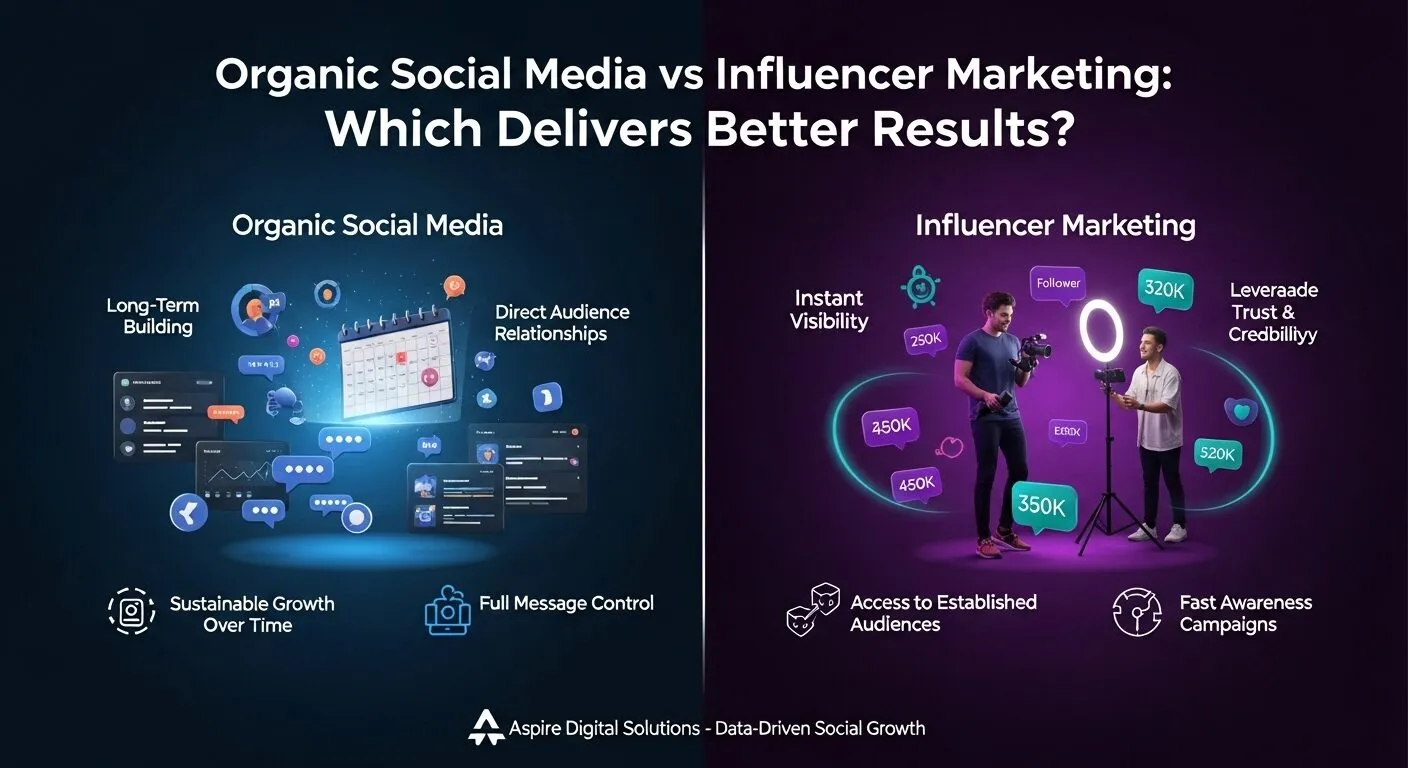
| Factor | Organic Social Media | Influencer Marketing |
|---|---|---|
| Audience source | Your own followers | Creator's followers |
| Cost | Lower direct cost, higher time cost | Can require creator fees, product cost, or commission |
| Speed | Slower growth | Faster audience access |
| Trust source | Built through brand consistency | Borrow source |
| Builted from creator credibility | ||
| Control | High brand control | Shared control with creator |
| Content style | Brand-led | Creator-led |
| Best for | Retention, education, community | Awareness, product launch, trust transfer |
| Main risk | Low reach without consistency | Poor creator fit or weak disclosure |
| Content lifespan | Can support long-term brand memory | Often creates short-term spikes unless reused |
| Measurement | Engagement, saves, comments, profile visits | Reach, clicks, sales, creator content performance |
The Mechanism: Why These Strategies Work Differently
Organic social media works through repeated exposure. A person sees your brand multiple times, understands your point of view, notices your consistency, and slowly builds confidence.
Influencer marketing works through trust transfer. A person already trusts a creator. When that creator recommends a product, some of that trust moves toward the brand.
The difference is simple:
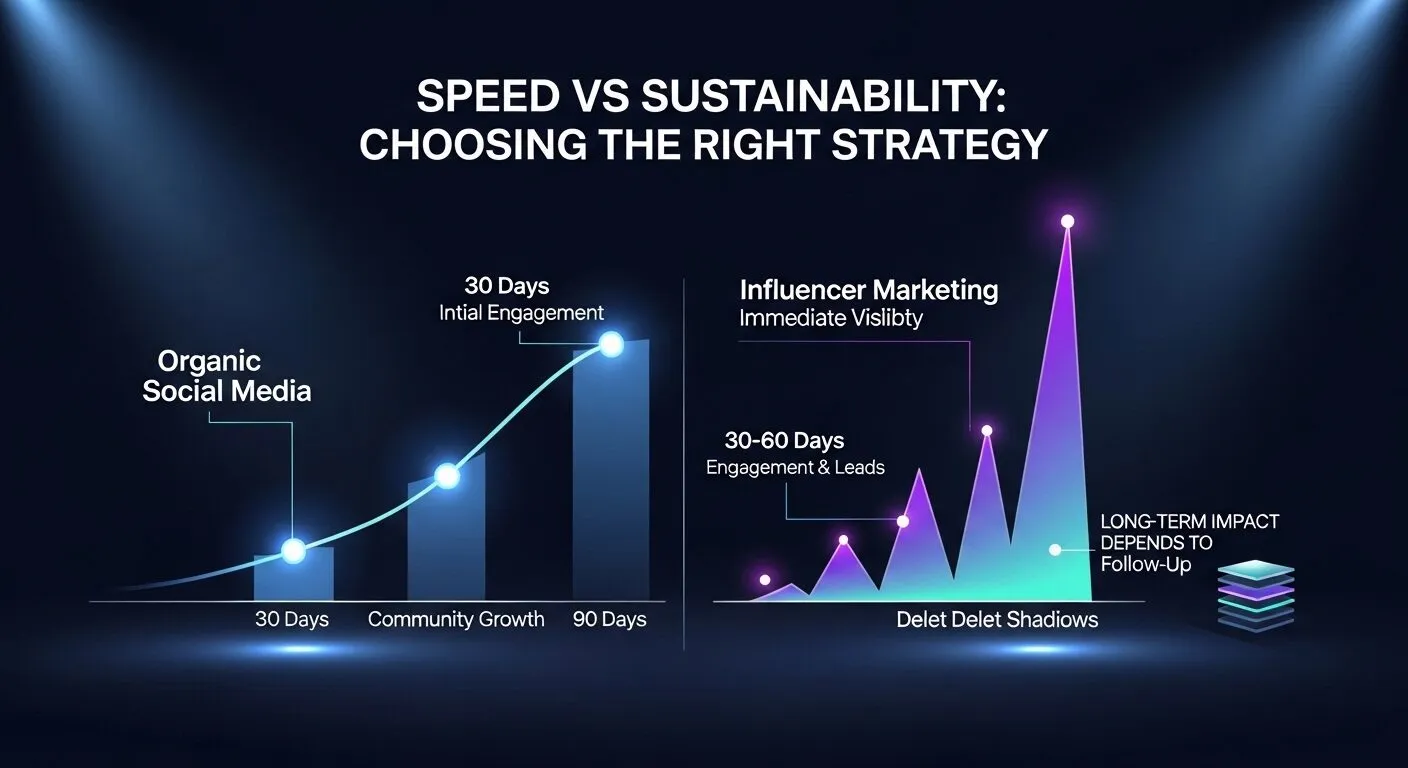
This is why influencer marketing can create fast attention, but organic social media is needed to keep that attention after the campaign ends.
Cause → Process → Outcome
Organic Social Media
Influencer Marketing
Combined Strategy
Which One Is Better?
Neither strategy is always better. The right choice depends on the goal.
Use organic social media when you want to build a long-term audience, improve brand memory, answer customer questions, show expertise, and create a trusted brand presence.
Use influencer marketing when you want faster reach, social proof, product awareness, launch momentum, creator-generated content, or niche audience access.
Use both when you want awareness and retention together.
Decision Matrix: Which Strategy Should You Choose?
| Business Goal | Best Choice | Reason |
|---|---|---|
| Build long-term brand trust | Organic social media | Trust grows through repeated brand interaction |
| Launch a new product quickly | Influencer marketing | Creators can create fast awareness |
| Educate customers before purchase | Organic social media | Brand-owned content can answer objections |
| Reach a niche audience | Influencer marketing | Niche creators already gather specific communities |
| Build a low-cost presence | Organic social media | No direct media spend is required |
| Get content for ads and posts | Influencer marketing | Creator content can be reused with permission |
| Improve customer loyalty | Organic social media | Ongoing interaction supports retention |
| Create immediate social proof | Influencer marketing | Creator endorsement can reduce buyer doubt |
| Support SEO and AI visibility | Organic social media plus website content | Consistent entities, topics, and brand signals help content clarity |
| Scale a campaign | Combined approach | Influencers create reach; organic and paid systems extend impact |
The Attract → Absorb → Convert Framework
The strongest strategy is not "organic vs influencer." It is using both in the correct order.
1. Attract
Influencer marketing attracts new people who may not know the brand. This works well for launches, offers, awareness campaigns, and product education.
2. Absorb
Organic social media absorbs the attention. When people visit the brand profile after seeing an influencer post, they should find clear posts, proof, FAQs, reviews, and educational content.
3. Convert
The website, landing page, WhatsApp, lead form, booking page, or store converts interest into action. Without a conversion path, both organic content and influencer content can lose value.
Organic Readiness Checklist
Before running influencer campaigns, check whether your organic profile can support new traffic.
| Question | Yes/No |
|---|---|
| Does your bio clearly explain what you sell? | |
| Do you have recent posts from the last 30 days? | |
| Do pinned posts explain your offer, proof, and best content? | |
| Do you show customer reviews or real outcomes? | |
| Do you answer common buyer questions? | |
| Is your contact link working? | |
| Is your visual identity consistent? | |
| Do you have product or service highlights? | |
| Do your captions sound clear and credible? | |
| Can a new visitor understand your value in 10 seconds? |
Score Guide
| Score | Recommendation |
|---|---|
| 8–10 yes answers | Ready for influencer campaigns |
| 5–7 yes answers | Improve organic profile before scaling |
| 0–4 yes answers | Build organic foundation first |
Creator-Fit Scoring System
Do not choose influencers only by follower count. Use this scoring model.
| Criteria | Score |
|---|---|
| Audience match | 25 |
| Engagement quality | 20 |
| Content quality | 15 |
| Brand safety | 15 |
| Past campaign relevance | 10 |
| Comment authenticity | 10 |
| Disclosure habits | 5 |
| Total | 100 |
Score Guide
| Score | Recommendation |
|---|---|
| 80–100 | Strong creator fit |
| 60–79 | Good fit with review needed |
| 40–59 | Risky fit |
| Below 40 | Avoid |
KPI Ladder: What to Measure
| Funnel Stage | Organic Social KPIs | Influencer Marketing KPIs |
|---|---|---|
| Awareness | Reach, impressions, profile visits | Creator reach, video views, campaign impressions |
| Engagement | Comments, saves, shares, replies | Comments, shares, story taps, audience questions |
| Trust | Review engagement, repeat comments, DMs | Sentiment, comment quality, creator credibility |
| Traffic | Link clicks, bio clicks | UTM clicks, landing page visits |
| Conversion | Leads, purchases, bookings | Sales, coupon use, affiliate revenue |
| Retention | Repeat engagement, community growth | New followers retained after campaign |
Common Mistakes
Many brands pay creators, get profile visits, and lose the opportunity because their own profile is weak. Influencer content can bring attention, but organic social must hold that attention.
Large audiences do not always mean strong results. A smaller creator with a relevant audience and strong comments can perform better than a large creator with weak trust.
Influencer marketing works because the creator has their own voice. If the content feels like a brand script, it may lose credibility.
Organic content needs a system. A strong profile usually includes education, proof, product explanation, founder perspective, customer stories, and community interaction.
Paid or gifted influencer content may require clear disclosure. Hidden sponsorships can damage trust and create compliance risk.
Without UTM links, coupon codes, affiliate links, or campaign landing pages, it becomes hard to know which creator or content format produced results.
Edge Cases
Small Businesses
Small businesses should usually build an organic foundation first, then test micro-influencers. This reduces risk and improves conversion from new profile visits.
B2B Companies
For B2B brands, influencer marketing may work better through industry experts, LinkedIn creators, podcast guests, analysts, consultants, or niche educators rather than lifestyle influencers.
Local Businesses
Local restaurants, salons, clinics, gyms, real estate firms, and education brands can benefit from local creators. The best creator is often someone trusted in the same city, not someone with the largest national following.
Regulated Industries
Finance, healthcare, legal, education, and wellness brands need strict claim review. Influencer content should not make unsupported promises.
New Brands
New brands should use organic social to explain who they are, why they exist, what they sell, and why people should trust them before spending heavily on creators.
Local Context: India
For Indian brands, influencer marketing should include clear disclosure practices. Sponsored, gifted, affiliate, or paid creator content should be labeled clearly according to applicable advertising guidance. Virtual influencers and AI-generated personalities also require extra transparency because audiences may not realize they are not interacting with a real person.
India also has strong regional-language creator ecosystems. For many local and D2C brands, a Kannada, Hindi, Tamil, Telugu, Malayalam, Marathi, Bengali, or regional city-based creator may drive better trust than a national creator with a broad but less relevant audience.
For businesses investing in Social Media Marketing Services in Mysore, understanding regional creator fit is essential.
Best Strategy by Budget
| Budget Level | Recommended Strategy |
|---|---|
| Very low budget | Build organic social first, use customer stories, founder content, and community posts |
| Low budget | Add micro-influencers, gifting campaigns, and local creators |
| Medium budget | Combine creator campaigns with strong organic content and landing pages |
| Higher budget | Use long-term creator partnerships, paid amplification, UGC licensing, and conversion tracking |
How to Combine Organic Social Media and Influencer Marketing
Step 1: Prepare the Brand Profile
Before creator content goes live, update your bio, pinned posts, highlights, product posts, testimonials, and contact links.
Step 2: Select Creators by Audience Fit
Review comments, audience type, content tone, past brand work, and disclosure behavior.
Step 3: Write a Clear Brief
The brief should include the campaign goal, key message, product facts, claim limits, content format, disclosure requirement, posting timeline, and usage rights.
Step 4: Let the Creator Keep Their Voice
Give direction, not a full script. Creator content should feel natural to the creator's audience.
Step 5: Repurpose the Best Content
With permission, reuse creator content on organic social, ads, landing pages, email campaigns, and product pages.
Step 6: Track Campaign Results
Use UTM links, coupon codes, landing pages, affiliate links, and post-campaign reporting.
Step 7: Keep New Followers Engaged
After the campaign, post FAQs, testimonials, product education, behind-the-scenes content, and customer stories. This turns short-term attention into long-term brand value.
For brands investing in Social Media Marketing Services in Bangalore, combining both approaches with proper tracking delivers the strongest outcomes.
Expert Commentary
Organic social media and influencer marketing should not be treated as separate silos. Organic social is the brand's home base. Influencer marketing is an audience bridge. A campaign fails when the bridge sends people to a weak home base.
The most useful question is not "Which is better?" The better question is: "Do we need reach, trust, retention, or conversion right now?"
If the brand lacks reach, influencers can help. If the brand lacks trust, organic proof and creator credibility both matter. If the brand lacks conversion, neither strategy will work well until the offer, landing page, and follow-up system are fixed.
For deeper clarity on what content actually drives results, see What Type of Social Media Content Actually Converts in 2026.
Frequently Asked Questions
Organic social media is better for long-term trust, education, and community. Influencer marketing is better for faster reach and social proof. The stronger choice depends on the business goal.
Yes. Influencer marketing is often part of a broader social media strategy, but it is different from organic brand-owned posting because the content is created or distributed through a creator's audience.
Yes. Organic social media can generate sales when the content answers buyer questions, shows proof, explains the offer, and gives users a clear next step.
It can create awareness, but results may be weaker if the brand profile is not ready. Many users check the brand's own page before buying or following.
The biggest difference is the source of trust. Organic social builds trust directly through the brand's own content. Influencer marketing borrows trust from a creator.
Yes, but small businesses should usually start with micro-influencers, local creators, or niche experts after building a strong organic profile.
Track reach, engagement, link clicks, coupon use, landing page visits, sales, new followers, and retention after the campaign.
Track reach, saves, shares, comments, profile visits, link clicks, direct messages, follower quality, and content-assisted conversions.
In many markets, paid, gifted, affiliate, or sponsored influencer content must be clearly disclosed. Brands should check the rules that apply in their location and platform.
Use influencers to bring new attention, use organic social to educate and build confidence, then use a landing page or contact path to convert interested users.